REFLEXOLOGY REVISITED · COURSE REVIEW EDITION
← All chapters

Chapter 12 / 12 · 8 lessons

Starting a sustainable practice

Plan a realistic first offer, including costs, time and responsibilities.

Review marks stay on this device.

Lessons

Chapter overview

Reflexology with Ruth • Section 12

Start small enough to learn. Plan carefully enough to keep going.

You do not need a perfect spa to begin planning a thoughtful practice. You need a clear service, an appropriate place, permission to offer that service, a workable budget, and a way for people to find and book you. A beautiful room cannot compensate for unclear boundaries or a price that leaves you exhausted.

Ruth's experience anchors this section: small spaces, pop-ups, genuine photographs, online booking, and word of mouth. The budgets, sample policies, activities, and launch plan are added teaching examples, not her private financial records or promises of results. All example money is U.S. dollars. The research framework is U.S.-focused because no student locations were supplied; learners elsewhere must identify their equivalent authorities.

This is a complete written teaching draft. Instructor adoption and filming remain. Completing it does not grant a professional license or establish permission to practice in a particular place.

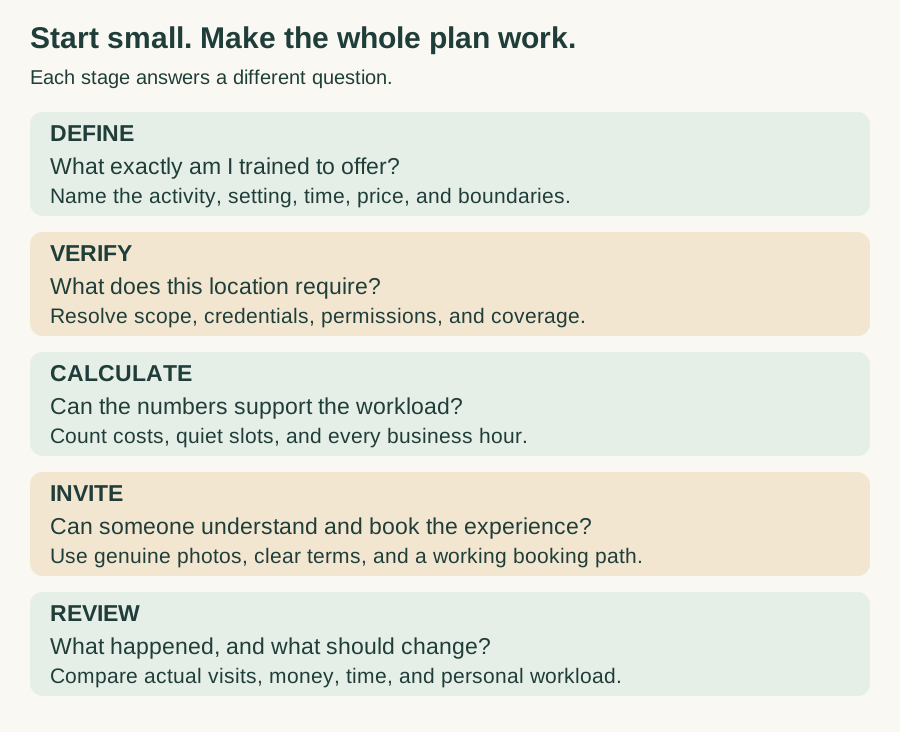
A five-stage pathway from clear service to a sustainable review

Lessons

Your learning route

Suggested pace: 90 minutes for eight short lessons, 30 minutes for scenarios and the knowledge check, and 60 minutes to draft the workbook. Local research happens separately and may take days or longer. A launch date follows readiness, not the course calendar.

By the end, you will be able to:

  • Describe one service accurately, including duration, price, boundaries, and setting.
  • Compare pop-up, mobile, shared-room, and dedicated-room models.
  • Identify the authorities and unresolved requirements for your actual location and touch activities.
  • Separate startup costs, ongoing fixed costs, variable costs, revenue, and owner compensation.
  • Calculate capacity and earnings using both contact time and administrative time.
  • Draft fair booking policies and a realistic first-client plan.
  • Produce a practical business outline, cost worksheet, and requirements register.

Bring: your Section 2 scope and consent notes, Section 5 space checklist, Section 10 documentation approach, Section 11 assessment feedback, a calculator, and the city/county/state or equivalent where you hope to work. If your location is undecided, compare two candidates and keep both marked unresolved.

Opening activity: Imagine your first paying client leaving. What do you want them to understand about what happened, what they paid for, and how to book again? Write three sentences before planning decor.

My three sentences: ___

Lessons

Lesson 12.1 · Define the service before buying the room

About 10 minutes • Outcome: a service someone can understand without explanation.

Ruth recalls initially approaching her business as though she were a massage therapist, although she was not one. The transferable lesson is to build around the work you are actually trained and permitted to offer. An equipment label such as “massage chair” does not authorize massage, and calling regulated touch “relaxation” does not make a legal requirement disappear.

Begin with one service and one setting. Describe the body areas involved, clothing or footwear arrangements, client position, appointment length, approximate contact time, price, and how a person can ask for changes. Only include scalp or head work if both your training and the applicable rules allow it. Do not borrow massage, medical, or other protected titles to sound established.

Example service description — teaching proposal: “A 20-minute seated hand-relaxation appointment, including a brief comfort check, approximately 12 minutes of familiar hand contact, and time to close. You remain clothed and may ask to change or stop the contact at any point. This service does not diagnose or treat a medical condition.” Use only where that actual activity is permitted. The example price of $25 is a budgeting assumption, not a local recommendation.

Words to avoid: cure, detoxify organs, diagnose imbalances, guaranteed pain relief, or claims that a private course award is a government license. Advertisements must be truthful and supported; a testimonial or disclaimer does not rescue an unsupported health claim. FTC advertising guidance

Try it: Tell a partner what you offer in 20 seconds. Ask them to repeat the length, price, body area, and purpose. Rewrite anything they misunderstand.

My starting service / included time / excluded services / accurate title: ___

Lessons

Lesson 12.2 · Choose the smallest workable setting

About 10 minutes • Outcome: a setting with manageable commitments.

Ruth suggests looking for a boutique, antique market, spa, or other compatible business with a small space. A welcoming seated setup and a screen can make a short experience feel considered. Treat this as a starting idea to evaluate, not a complete equipment specification for every modality.

Model What makes it attractive What to investigate before committing
Occasional pop-up Limited dates; existing foot traffic Event permission, service rules, privacy, hand hygiene, access, storage, host fee and cancellation terms
Mobile visits No permanent treatment-room rent Travel time, parking, safe access, insurance for mobile work, personal check-in plan, suitable space in each home
Shared room More privacy with limited rental hours Lease permission, licensed establishment rules, cleaning, locked storage, signage, booking conflicts
Dedicated room Consistent environment and availability Rent during quiet weeks, deposit, utilities, access, permits, insurance, minimum lease term and exit costs

Choose equipment for the work. A forward-leaning chair may suit certain seated activities but is not automatically appropriate for foot access, head positioning, or every client's mobility. Rehearse with your intended setup before buying it. Provide another permitted, supported position when needed; do not improvise transfers you cannot safely assist with.

Minimum planning categories: stable cleanable seating/supports; practitioner seating; clean coverings; hand-hygiene access; surface-cleaning supplies compatible with the equipment; separate clean/used storage; secure records and payment method; visible service information; privacy arrangements; accessible entry and an unobstructed exit. Verify venue sanitation requirements. A screen blocks sight, not sound. Default to fragrance-free and ask about sensitivities before optional products.

A host conversation: “I am exploring a small relaxation service, subject to confirming local requirements. Could we discuss permitted use, access, privacy, cleaning, rent, insurance, and who handles bookings? I would like written terms before confirming dates.”

Put dates, hours, fixed fee or percentage, payment handling, refunds, setup/storage, utilities, client-record ownership, photo rules, damage responsibilities, and cancellation/exit arrangements in writing. Do not assume the host's insurance covers your work.

Try it: Walk the space from the client's perspective. Where do they wait, put belongings, discuss private information, wash hands, sit, pay, and leave?

Lessons

Lesson 12.3 · Resolve requirements for your actual work

About 15 minutes • Outcome: a research trail, not a guess.

Ruth wants students to take responsibility for practicing legally where they live. Turn that responsibility into a repeatable research skill. Requirements may exist at state, county, city, venue, or professional-board levels. Start with your precise location and a plain description of every activity, including feet, hands, head/scalp, tools, products, home visits, and public events. SBA launch guidance

A real example of why this matters: Washington's Department of Health says a person must obtain reflexologist certification or a massage-therapist license before practicing reflexology or representing themselves as a reflexologist. This is an example, not a rule for all states, and this course does not claim to meet that state's education requirements. Washington DOH reflexologist FAQ
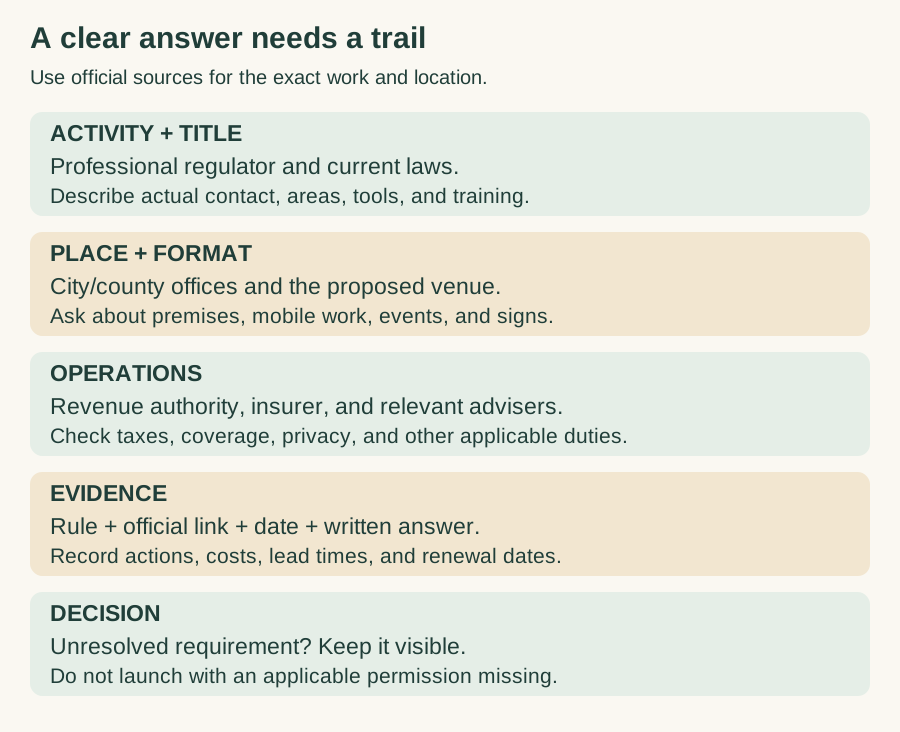
Requirements research moving through scope, location, operations and evidence

Research method: Find the official professional regulator first; search its laws and scope definitions. Then contact city/county business licensing and zoning offices, the revenue authority, the venue, and an insurer. Describe your actual service, not just its marketing name. Save the official link, section, date, and any written reply. Ask a qualified local adviser when rules conflict or the answer is unclear. Recheck before launch and when your service or location changes.

Suggested inquiry: “I plan to provide [exact activities and body areas] at [address or service area], for [paid/free practice], using [equipment/products]. Which practitioner credentials, establishment approvals, business permits, zoning rules, and restrictions apply? Please direct me to the current rule and any required application. Does the answer change for public events, mobile visits, or unpaid student practice?”

Check name/registration and business structure, tax registration, any service sales tax, zoning/home-occupation/event/sign permits, professional and general liability cover, record privacy and retention, and any accessibility obligations. This is a research checklist; applicability varies. LLC formation, an insurer's acceptance, or a landlord's approval is not a professional license.

Important distinction: Friends, free sessions, donations, or tips do not automatically exempt an activity from regulation. Verify the rules and training/supervision conditions before using practice sessions as your first step. Consent remains necessary even with friends.

Try it: Find one official authority for your intended location. Record one question that remains unresolved rather than treating a search result as clearance.


Lessons

Lesson 12.4 · Count what it really costs

About 12 minutes • Outcome: a budget with no invisible categories.

Separate three buckets. Startup cash is what you need before opening. Fixed operating costs continue even when the appointment book is empty. Variable costs rise as sessions are delivered. Owner pay, taxes, and a contingency reserve must also be planned; they do not vanish because you enjoy the work.

Fictional pop-up startup allowance — not vendor quotes or Ruth's expenses:

Startup item Planning allowance
Suitable client seating/supports $250
Screen $80
Practitioner stool and small surface $90
Washable coverings and initial hygiene supplies $100
Transport bags and separate storage $60
Basic real-photo flyer/sign printing $40
Known-item subtotal $620
Contingency for these known items, 15% $93
Known-item planning total $713

This is not the complete amount needed to open. Add actual training/credential costs, permits, insurance payments due before launch, deposits, booking/payment equipment, accessibility adjustments, and an operating reserve. Write unknown amounts as “quote needed,” never $0. A venue fee in the operating budget is different from a refundable deposit; track cash tied up in deposits separately.

Fictional monthly fixed-cost case: $200 venue dates + $35 insurance allowance + $20 booking system + $25 phone/admin allocation + $30 marketing = $310/month. Annual insurance may be paid up front even when you allocate it monthly. Avoid counting the same payment twice when estimating required cash.

Variable cost assumption: $4 per completed 20-minute appointment for consumables, laundering, and transaction charges combined. Obtain actual quotes: payment fees may include both a percentage and a fixed amount, so a changed price may change this assumption. Mobile travel and host percentage fees belong in the model when applicable.

Tax correction: Ruth describes business expenses as potentially helpful at tax time. In U.S. federal rules, expenses generally must be ordinary and necessary to qualify, with other rules affecting timing and treatment. Startup costs, equipment, and mixed personal/business use may need different handling. A deduction reduces taxable income; it is not reimbursement. Do not open a loss-making practice simply to create write-offs against household income. Keep records and ask a tax professional how the rules apply. IRS Publication 583

Try it: Identify one purchase you can postpone without compromising safe, lawful service. Put the saving into your reserve rather than spending it on another accessory.

Lessons

Lesson 12.5 · Price for the whole job

About 12 minutes • Outcome: a price supported by arithmetic.

Ruth reports charging $60 for an hour of reflexology and staying busy. She mentions roughly $90 massage appointments and scalp sessions as high as $129 in her experience. These are personal observations, not a current market survey or recommended price range. Her reported three to seven clients in a day does not establish a beginner's safe workload or your likely income.

Choose a price by combining real local comparisons, your service and setting, expected demand, costs, and a sustainable workload. Record the date, appointment length, actual contact time, setting, and inclusions when comparing three local providers. Avoid assuming that the lowest price is the strongest offer.

Contribution per completed appointment = collected price − variable cost.

Operating break-even appointments = fixed operating costs ÷ contribution, rounded up. This covers modeled operating costs only; it excludes owner compensation, taxes, and recovery of startup spending.

Target appointments = (fixed costs + desired owner compensation + planned reserve/startup recovery) ÷ contribution, rounded up. Treat the compensation target here as before personal taxes. Ask an adviser about tax reserves rather than using a universal percentage.

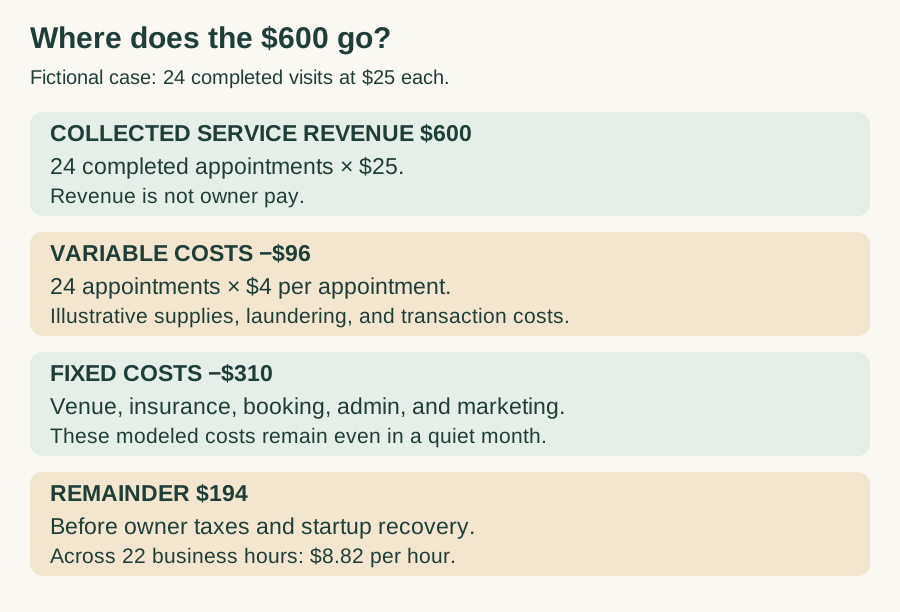
The fictional pop-up budget at 24 completed appointments

For the fictional pop-up: $25 collected − $4 variable = $21 contribution. Fixed costs of $310 ÷ $21 = 14.76, so operating break-even is 15 completed appointments/month. To provide $400 owner compensation and add $100 to reserve/startup recovery: ($310 + $400 + $100) ÷ $21 = 38.57, or 39 completed appointments. If you only have 24 slots, that target cannot be reached with that schedule and price.

Completed appointments Collected revenue at $25 Variable costs at $4 Fixed costs Remainder before owner taxes/startup recovery
12 $300 $48 $310 −$58
18 $450 $72 $310 $68
24 $600 $96 $310 $194

Price-floor exercise: With 24 completed appointments, a $400 compensation target and $100 planned reserve require $4 + ($310 + $400 + $100) ÷ 24 = $37.75 per appointment, assuming variable cost stays $4. This is a planning floor under those assumptions, not proof that customers will pay it. If only 18 attend, the same target requires $49.00. Revisit price, cost, schedule, or the income target rather than hiding the gap.

Keep collected sales tax separate from service revenue where applicable. Model discounts, refunds, and card charges honestly; do not count uncertain tips or cancellation charges as essential income. Do not stack overlapping promotions or promise a permanent low rate that your costs cannot support.

Cost and capacity calculator

Try your own numbers

Planning tool • USD • Assumes one service, constant variable cost and no unmodeled fees. Includes marketing once in fixed costs. Results are before personal taxes.

Calculator entries are temporary practice values. Add a comment above to record your review.

Lessons

Lesson 12.6 · Put unpaid time on the calendar

About 10 minutes • Outcome: a schedule that leaves room to work well.

Ruth notes that she has not closely tracked unpaid administration; planning can blend into an enjoyable evening. Enjoying the work does not make that time free. Track messaging, booking, bookkeeping, laundering, purchasing, cleaning, travel, setup, advertising, and follow-up for two weeks. Use totals to change the schedule rather than judging yourself for them.

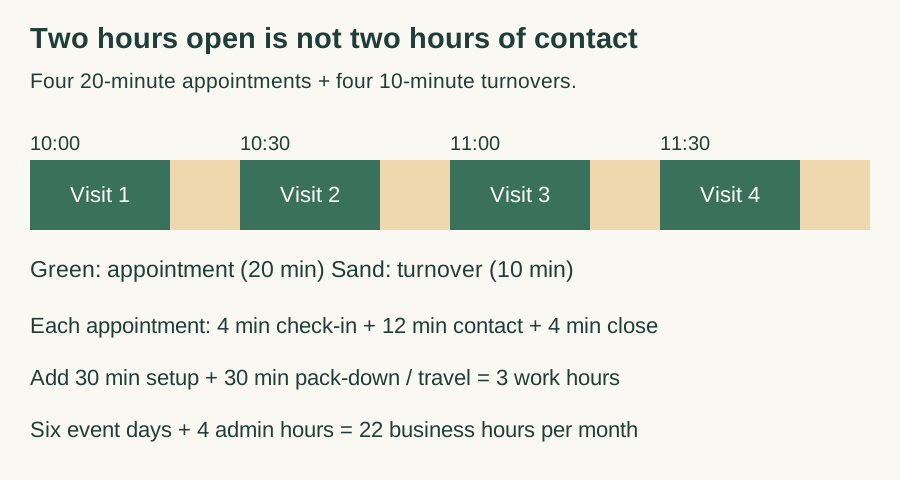
Fictional pop-up day: two hours open for bookings, four 20-minute appointments, a 10-minute turnover after each appointment, plus 30 minutes setup and 30 minutes pack-down/travel combined. Total business time: three hours. Choose actual travel allowances for your location.

A two-hour booking block containing four appointments and four turnovers

Clock time Task
9:30–10:00 Setup and readiness checks
10:00–10:20 / 10:20–10:30 Appointment 1 / turnover
10:30–10:50 / 10:50–11:00 Appointment 2 / turnover
11:00–11:20 / 11:20–11:30 Appointment 3 / turnover
11:30–11:50 / 11:50–12:00 Appointment 4 / turnover
12:00–12:30 Pack-down and allocated travel

Within each 20-minute appointment, allow 4 minutes for check-in/consent, about 12 for contact, and 4 for closing/payment. This is not 20 minutes of hands-on work. Publish that distinction. Turnover protects cleaning, notes, and your reset; it is not automatically adequate as a meal or rest break during a longer day.

Six such days produce 24 available slots and 18 scheduled work hours. Add 4 monthly administration hours: 22 total business hours. At 24 completed appointments, $194 ÷ 22 = $8.82 per business hour before taxes and startup recovery. At 18 completions, $68 ÷ 22 = $3.09, if all six event days and administrative hours still happen. At 12, the business runs at a modeled loss. A quiet slot still consumes time if you remain at the event.

Separate hour-session example: four $60 appointments earn $240 gross. Four 75-minute slots, including turnover, plus one administrative hour take six hours. Gross revenue per business hour is $40, before any expenses or taxes. “$60 an hour” on the menu does not mean $60 take-home for every hour you work.

Try it: Start with a modest pilot workload, protect breaks, and record fatigue and quality alongside attendance. Expand only when both the financial model and your actual tolerance support it. Bound booking availability and response hours so online booking does not mean being on call all night.

Lessons

Lesson 12.7 · Policies are part of hospitality

About 10 minutes • Outcome: clients know what to expect before booking.

A policy prevents an uncomfortable surprise. Write it in the same calm voice you use with a client. Display material terms before booking, obtain acknowledgment, and send a confirmation with directions, arrival instructions, accessibility contact, service/price/time details, and cancellation options. Adapt the drafts below to local law, insurer requirements, and your actual operation.

Topic Starter wording or decision
Cancellation “Please give 24 hours' notice when possible. For this pilot I will not charge a late-cancellation fee. Repeated missed visits may mean that I cannot reserve another appointment.” A later fee/deposit policy needs clearly disclosed lawful terms and reliable consent.
Late arrival “We will discuss a shorter session within your booked time. If there is not enough time to work appropriately, we will reschedule; I will explain any applicable payment terms before we decide.”
Practitioner cancellation “If I cancel, you may choose a new appointment or a refund of any prepaid unused service.”
Illness or unsuitable session “Contact me before attending if something may affect suitability. We can pause or reschedule without pressure to receive touch.” Do not encourage attendance to avoid a penalty.
Consent “You may decline an area, request a change, or stop contact. We will not continue because a session has been paid for.” Explain any refund policy without using it to discourage stopping.
Photos “Service consent and photo permission are separate. Declining photos does not affect your care.” Record uses, identifiable features, storage, and any withdrawal limits before filming.
Privacy “I collect only information needed for this service and explain how it is stored and shared.” Use suitable secure systems; do not promise blanket HIPAA compliance without determining applicability.
Complaints Give a contact method and a realistic acknowledgment target, such as two business days. Document the concern, respond respectfully, and follow any regulator/insurer reporting duties.

For home visits, define service area, travel fee, parking, pets, smoke, access, and the conditions needed for an appropriate setup. Use a personal safety check-in arrangement without unnecessarily sharing client information. For minors, resolve consent, safeguarding, and insurance requirements before accepting bookings; a beginner pilot may choose adult clients only.

Keep prepaid packages and gift certificates out of your initial offer until you understand expiry/refund rules and how you will track unearned service obligations. A sale today can create work you still owe later.

Role-play: A client arrives 12 minutes late for a 20-minute appointment. Practice explaining why rushing the contact or skipping consent is not an option. Offer a clear next step using your published policy.

Lessons

Lesson 12.8 · Help the first clients find you

About 11 minutes • Outcome: a small, measurable client plan.

Ruth's strongest marketing observation is visual: show real hands offering the actual experience. She reports better results from flyers with authentic photographs than from business cards alone, and describes clients finding her through social media, a vehicle graphic, and Google searches. These are her results, not guaranteed outcomes.

Make one honest photo useful. With separate written permission, photograph an actual demonstration in your real setting. Show the contact and support clearly; use good natural light and an uncluttered background. Avoid identifying details unless permission covers them. Do not use AI imagery as proof of your work, and do not present a staged learner demonstration as a paying-client testimonial. The original diagrams in this lesson are teaching graphics, not client photographs.

A flyer needs five answers: What is it? Who offers it and with what accurate credentials? Where/when? How much time and money? How do I book or ask about access? Include a readable short link alongside any tested QR code. If no authentic photo is available yet, use a simple text flyer until you can obtain one rather than substituting misleading imagery.

Draft flyer copy: “A quiet break for busy hands. Seated hand-relaxation appointments at [confirmed venue]. 20 minutes including check-in and closing • $25 introductory pilot price • [dates]. Offered by [name and accurate credential]. Book at [verified link] or contact [business contact] for access questions.” This is a fictional service offer for adaptation after clearance, not an advertisement already published.

Channel choices: Ask a compatible host about approved on-site promotion. Share truthful business-page or Instagram posts under current platform rules. Ruth mentioned Marketplace, but a Marketplace service listing and a paid ad placement are different products; this lesson does not authorize a service listing there. The current Meta help page was inaccessible during this research, so students must check the current rules for their exact product/account before using it. Do not disguise a service as a physical item. Meta help entry point

Google correction: Rent alone does not establish Business Profile eligibility. Google supports eligible businesses with customer-facing premises and eligible service-area businesses that visit customers. Address display, signage, and shared-space conditions matter; do not list a pop-up host's address merely because you paid a fee. Check your actual arrangement. Google Business Profile guidelines

Test a small budget: Ruth reports experiments as low as $3/day and sometimes several rapid bookings. A fictional 10-day test would cost $30 if the platform permits that budget. If it produces three new clients who actually attend, acquisition cost is $10/client. At a $25 price and $4 variable cost, three sessions leave $63 before marketing and fixed costs, or $33 after the $30 ad. Since the monthly example already includes $30 marketing, do not subtract it twice. Track completed first visits, not likes or unconfirmed bookings; if none attend, the campaign has spent $30 without an observed acquisition result.

Referral invitation: “If someone you know would enjoy this kind of appointment, you are welcome to share my booking page. No pressure.” Do not collect friends' contact details without their permission. Ask for honest feedback without requiring praise or offering rewards for positive reviews. Professional referrals should support appropriate care and privacy, not imply that a clinician endorses unproven treatment claims. Avoid referral commissions until their legality and professional implications have been checked.

Practice & reference

Demonstration lab · From empty corner to first booking

A 15-minute instructor demonstration, followed by a student rehearsal.

Segment Show Ask learners to notice
0:00–3:00 Compare a plausible boutique corner with a blocked/noisy unsuitable space What can a screen solve? What remains unresolved?
3:00–6:00 Lay out only the equipment needed for the selected permitted service Which purchases support comfort, hygiene, access, or privacy?
6:00–9:00 Explain one service menu and rehearse a 20-minute appointment budget Is contact time clear? Where does consent fit?
9:00–12:00 Walk through the fictional cost and capacity figures Why can a fully booked pilot still pay very little?
12:00–15:00 Show a consented real photograph and a sample booking confirmation Can a stranger understand the offer and the terms?

Instructor prompt: “Which expense would you delay, and which requirement would stop you opening?” Invite students to explain the decision, not simply name the cheapest option.

Student rehearsal: Use a table, chairs, and paper floor labels. No touch is required for this business exercise. Rehearse the host discussion, client explanation, and late-arrival conversation. A partner identifies one unclear promise and one uncounted task.

Practice & reference

Workbook · My practical business outline

Use this as your one-page decision brief. Fictional learning data only in the browser. Print or save a PDF to keep your entries; this page is not a business-record system.

Practice name and accurate practitioner title: ___

Location: country / state or region / county / city / proposed venue or mobile area: ___

Client group and practical need I intend to serve: ___

First service: exact activities/body areas, appointment length, contact time, position, price and exclusions: ___

Chosen setting and why it fits my budget, access needs, training and service: ___

Minimum equipment I need now / purchases I can defer: ___

Available booking days, slots per day, turnover, breaks, setup, travel and weekly admin time: ___

How clients book, pay, understand policies and contact me: ___

Two initial marketing channels and the maximum trial budget: ___

Referral approach and a plan for requests outside my scope: ___

What must be resolved before launch / owner of each action / review date: ___

Success measures after the pilot: completed visits, total hours, operating remainder, client feedback, personal workload and repeat bookings: ___

My decision rule for continuing, changing or pausing the model: ___

Practice & reference

Workbook · Cost and pricing worksheet

Replace every allowance with a dated quote or a clearly labeled estimate. Keep unresolved costs visible. These are cash-planning calculations, not a tax return or a formal profit-and-loss statement.

Startup items: item / quantity / unit cost / total / quote source and date / essential now or later: ___

Credential, registration, permits, insurance due, deposits, payment equipment and other unpriced startup needs: ___

Known startup total A / unresolved costs / contingency B / operating reserve C / total cash needed A + B + C once all costs are known: ___

Cash available / funding gap / how I will close the gap without assuming unbooked sales: ___

Fixed costs per month F: venue, insurance allocation, booking, phone/admin, marketing and other costs: ___

Variable cost per completed appointment V: consumables, laundry, payment fees, travel, venue commission and other costs: ___

Collected service price P, excluding any tax collected for the government: ___

Contribution P − V / operating break-even rounded up F ÷ (P − V): ___

Owner compensation target before personal taxes T / planned reserve or startup recovery R: ___

Target appointments rounded up (F + T + R) ÷ (P − V): ___

Available slots / realistic completed appointments N / reason for that attendance assumption: ___

Modeled remainder N × (P − V) − F / total business hours H / remainder per business hour: ___

Quiet-month scenario: lower N / unchanged costs / cash needed to keep going: ___

What changes if the target appointment count exceeds available slots? ___

Calculation rules: If P is less than or equal to V, no number of sessions covers positive fixed costs at that contribution. If N or H is zero, do not divide by it. Recalculate when a percentage fee, discount, service duration, or venue changes.

Practice & reference

Workbook · Requirements to resolve before paid services

Create one entry per requirement. Repeat the record below until every relevant question has an owner and evidence. “Not applicable” needs a reason and an authoritative source; “I have heard it is fine” is not a resolved status.

Research area Starting contact My status options
Permitted activities, titles, training, student practice Professional regulator and current statutes/rules Unresolved / application pending / confirmed applicable and satisfied / confirmed not applicable
Business registration and name State or equivalent registry; local licensing office Same four statuses
Premises, home occupation, event and mobile permissions City/county zoning and licensing; venue Same four statuses
Head/scalp work, products or tools beyond initial offer Relevant professional regulator Same four statuses
Tax registration, service tax, records and payments Revenue authority; qualified tax adviser Same four statuses
Coverage for activities and every setting Insurer, with written activity description Same four statuses
Privacy, retention, consent and accessibility obligations Relevant authority; qualified local adviser Same four statuses
Signage, photographs and promotional channels Local authority; venue; platform policies Same four statuses

Requirement name and exact service/location it applies to: ___

Authority / official URL / rule or section / date accessed: ___

Question asked and written answer or evidence saved: ___

Status / supporting reason / remaining action / person responsible / deadline: ___

Fee / lead time / expiry or renewal date / recheck trigger: ___

Launch decision: Which unresolved items prevent this service at this location? Name them explicitly. Do not offer paid work while an applicable credential or permission is missing. If one service is blocked, changing to another requires checking that service too.

My blockers and the evidence needed to close each one: ___

Practice & reference

Workbook · Time, policies and first clients

Two-week time audit: Repeat the following line for each work block. Keep client details out of it.

Date / activity / minutes / paid appointment or other business work / what I can simplify: ___

Total contact minutes / turnover / setup / travel / admin / marketing / total business hours: ___

Policy drafting: Write terms you could comfortably read aloud to a client.

Cancellation, no-show and late-arrival terms: ___

Practitioner cancellation, refunds and suitability-related rescheduling: ___

Consent, privacy, photographs, access requests and complaints: ___

First-client experiment: Select one offer, one or two channels, and a limited review period after launch clearance.

Offer / intended audience / genuine photo permission / booking link checked: ___

Channel / test dates / maximum spend / how clients can identify where they heard about me: ___

Inquiries / bookings / completed first visits / repeat visits / revenue / marketing cost: ___

Acquisition cost = campaign spending ÷ completed new clients / what the result means: ___

No completed new clients? Record the spend and “no completed acquisitions,” then inspect message clarity, targeting, price, access and booking usability. Do not manufacture a zero-cost success or assume more spending will solve it.

Practice & reference

Worked outline · Maya's six-date pop-up

Entirely fictional. Maya plans seated hand-relaxation appointments for adult shoppers at a boutique. She chooses a simple offer because it suits her intended setting; she has not yet verified that her training authorizes the activity locally.

Decision Maya's draft
Service 20-minute appointment, about 12 minutes of hand contact, $25, no head/scalp work
Venue Six two-hour booking blocks per month; written host terms still pending
Capacity Four slots/day × six days = 24 slots
Workload 18 event-related hours + four admin hours = 22 hours/month
Costs $713 known startup allowance, plus unpriced requirements and reserve; $310 fixed/month; $4 variable/visit
Attendance scenarios 12, 18, or 24 completed visits
Financial result −$58, $68, or $194 before personal taxes and startup recovery
Intended compensation $400 plus $100 reserve; requires 39 visits at the original price
Marketing One authentic photo flyer and one limited $30 campaign already inside fixed costs
Open requirements Regulator response, permit/zoning review, insurer confirmation, host agreement

What should Maya change? She should not label the model sustainable merely because 24 clients might book. She can research whether a higher price is viable, seek lower fixed costs, change the format or available dates if physically sustainable, or treat a tightly budgeted pilot as learning rather than income. Each change needs a new calculation. Signing a longer lease before those answers would increase the commitment without solving the arithmetic.

Her current decision: planning only. No paid launch date is announced until required permissions, coverage and suitable arrangements are resolved. Her incomplete outline is useful because it shows exactly what must happen next.

Practice & reference

Scenario lab · Choose before revealing

1. The inviting antique mall

A host offers a corner for $50 this weekend. They say, “You are only touching feet, so no permits are needed.” What is your next step?

Model response: Thank the host, describe the exact service to the relevant authorities, and verify professional and local venue requirements. Obtain written venue terms and insurance confirmation. The host's reassurance is not legal clearance; defer the event if you cannot resolve the applicable requirements in time.

2. The fully booked calendar

You have filled all 24 monthly appointments in the fictional case. Is the practice now paying you $25 per hour?

Model response: No. Revenue is $600; modeled operating costs are $406, leaving $194. Across 22 business hours that is $8.82 per hour before personal taxes and startup recovery. Full occupancy and sustainable compensation are different measures.

3. The exciting ad result

A $30 campaign produces five inquiries, three bookings, and two completed new-client visits. What is acquisition cost?

Model response: $30 divided by two completed new clients is $15 per acquired client. Note the inquiry-to-booking and booking-to-attendance gaps separately. Do not divide by five and call it customer acquisition cost; do not subtract the same campaign twice in the monthly budget.

4. The write-off temptation

A $900 decorative purchase seems easier to justify because “it will all come back at tax time.” What should you consider?

Model response: A deduction is not reimbursement. Check business need, cash affordability, documentation and applicable tax treatment. Postpone the purchase if it does not support the immediate service and would weaken the operating reserve.

5. The camera-ready client

A client agreed to receive a session and looks relaxed. Can you post a close-up of their feet without asking because their face is absent?

Model response: Obtain separate specific photo and publication permission. Feet, tattoos, jewelry and surroundings can identify a person. Service consent is not marketing consent. Use a permitted demonstration image or a text flyer if permission is unavailable.

6. The new scalp offer

A local scalp session costs more than your hand service. You want to add it tomorrow and call it reflexology. What needs checking?

Model response: Confirm competence, scope rules for actual head/scalp activities and products, insurance, suitable equipment, timing and cost. A label or another practitioner's price does not authorize the work. Keep the current offer until the new one is supported and permitted.

Practice & reference

Knowledge check · Twelve questions

Answer before opening the next section. Explain the reasoning briefly.

  1. What six facts make a service description clear? ___

  2. Why can a pop-up be easier to start but still unsuitable? ___

  3. Does free practice with a friend automatically avoid regulation? ___

  4. Which official source and evidence would you save when resolving a scope question? ___

  5. Classify a screen purchase, monthly room fee, and per-visit supplies. ___

  6. At $25 collected, $4 variable cost and $310 monthly fixed costs, what is operating break-even? ___

  7. Add a $400 compensation target and $100 reserve. How many completed visits are needed? ___

  8. With 18 completed appointments and 22 work hours in the fictional case, what is the remainder per business hour? ___

  9. Why is a deduction different from a refund of a business purchase? ___

  10. Does paying rent automatically make a Google Business Profile eligible? ___

  11. What permissions and truthful context do you need for a marketing photograph? ___

  12. Name three conditions that could prevent a paid launch even after finishing this course. ___

Practice & reference

Answer key · Explain the decision

  1. Appropriate answers include exact activities/body areas, purpose, position/clothing, appointment and contact time, price, accurate provider title and boundaries. Any six relevant facts that avoid a misleading promise are acceptable.

  2. A limited commitment can reduce overhead, but privacy, access, hygiene, regulation, equipment suitability, venue terms and demand still need evaluation.

  3. No. Check rules for the actual activity, student status and supervision as well as consent. Free service is not a universal exemption.

  4. The applicable professional regulator and current law/rule; retain the exact service/location question, official link and section, access date, written response, remaining actions and renewal/recheck dates.

  5. Screen: startup purchase. Monthly room fee: fixed operating cost. Per-visit supplies: variable operating cost. Tax treatment is a separate question.

  6. Contribution is $21. $310 ÷ $21 = 14.76, rounded up to 15 completed appointments. This is operating break-even, not a living-income target.

  7. ($310 + $400 + $100) ÷ $21 = 38.57, rounded up to 39. It exceeds a 24-slot schedule.

  8. 18 × $21 − $310 = $68; $68 ÷ 22 = $3.09 before personal taxes and startup recovery.

  9. A qualifying deduction reduces taxable income under applicable rules. It does not return the entire purchase price or make unnecessary spending profitable.

  10. No. The business and location/service-area arrangement must meet Google's current eligibility and representation rules.

  11. Separate specific permission for photography and the intended publication, honest identification of a staged demonstration where relevant, accurate service imagery and no unsupported outcome claims.

  12. Examples: missing credential, unresolved permitted activity, absent venue approval, unsuitable setup, inadequate insurance for the proposed activity, or an unresolved required business permit. A course certificate does not close these gaps.

Suggested learning threshold: 10 of 12 correct, plus correct explanations for questions 3, 4, and 12. Rework missed items with the relevant lesson. This teaching threshold is not professional authorization.

Practice & reference

Practical assessment · Is the plan usable?

Submit the business outline, cost worksheet, requirements register and a sample service description/policy page. A plan can pass the learning assessment while honestly remaining not ready to launch.

Domain Evidence of a usable plan Revise when
Service and scope Actual activity, title, timing, boundaries and setting are clear Credentials or health outcomes are overstated
Requirements Official sources, dates, statuses, action owners and blockers are recorded Assumptions appear as confirmed permission
Budget Startup/fixed/variable costs distinguished; unknowns visible Missing costs are entered as zero
Pricing Correct contribution, break-even, compensation and quiet-month calculations Gross revenue is called take-home pay
Capacity Total time includes turnover, travel, admin and breaks as needed Required sessions exceed feasible slots without a revision plan
Client experience Consent, booking, access, cancellation, privacy and complaint terms are usable Policies surprise or pressure the client
First clients Honest imagery, limited experiment, referral approach and attendance metrics Income promises or misleading claims replace measurement

Proposed scoring: 0 = absent or misleading; 1 = present but needs revision; 2 = clear and workable as a planning document. Aim for 12/14 with no zero. Any unsupported credential/health claim or falsely closed legal blocker must be corrected regardless of score. The reviewer assesses the plan's reasoning; they do not certify local legal compliance.

Before paid launch:

  • My exact service and title are permitted and within my competence.
  • Applicable credentials, business/venue permissions and coverage are in place.
  • The setup, access, hygiene, privacy and records arrangements are appropriate.
  • Price, appointment timing, boundaries and policies are clear before booking.
  • I understand startup cash needs, operating costs and a quiet-month scenario.
  • I have a manageable schedule and a measurable, truthful first-client plan.
  • My requirements register has no unresolved launch-blocking items.

Practice & reference

A first-month plan · Small steps with decision points

Use these as planning stages, not a promise that permissions can be obtained in a month. If requirements take longer, move the dates.

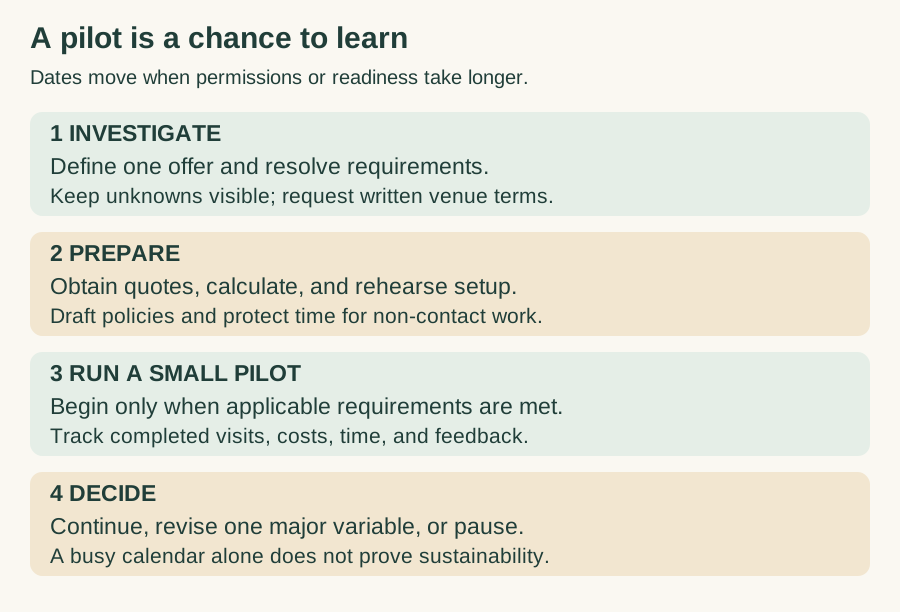
A four-stage pilot review from investigate to decide

Stage 1 — Define and investigate: Draft one service. Identify location and authorities. Start the requirements register. Compare settings and ask for written venue terms. Make no nonrefundable commitment based on an unresolved assumption.

Stage 2 — Cost and rehearse: Obtain quotes. Complete the cost worksheet and quiet-month scenario. Rehearse setup and client explanations without offering unapproved services. Draft policies. Establish bookkeeping categories and a separate business money trail.

Stage 3 — Prepare the invitation: Once permissions and arrangements are satisfied, create consented photographs, a clear booking page and confirmation. Test the full booking/cancellation path with a test record. Begin a small, bounded pilot; keep workload modest enough to learn from it.

Stage 4 — Review actuals: Count completed sessions, income, expenses, total hours, refunds, inquiries, repeat visits and fatigue. Ask what clients found clear or confusing. Continue, adjust one major variable, or pause. Do not increase ad spending merely because impressions rose.

Closing reflection: “The next step that makes my practice more workable is…” Be specific enough to put it on a calendar: call an authority, request a quote, test a booking form, or revise an appointment budget.

My next action / owner / date / evidence that it is complete: ___

Production & sources

Production notes and research

Source boundary: Ruth's supplied September 24, 2026 account supports the personal examples: pop-ups, a chair and screen, boutique/antique-market space, $60 hour sessions, variable daily volume, authentic photo flyers, low-budget advertising experiences, Google discovery, vehicle graphics, referrals, and untracked administrative time. Her comparisons with massage/scalp prices and advertising outcomes are anecdotal. No revenue records, cost ledger, location, or independently verified local permissions were supplied.

Added curriculum: The fictional Maya case, all budget allowances, capacity arithmetic, service wording, policy drafts, inquiry script, worksheets, assessment rules, diagrams and staged launch plan are editorial teaching additions. They should not be narrated as Ruth's personal history. The lesson makes specific corrections to broad tax and Google-eligibility statements. It does not make a nationwide exemption claim or advise Marketplace service listings.

Filming brief: Record the demonstration lab with a consenting adult model and a real permitted setup. Capture wide access/setup shots; close shots of clean/used storage and supports; an overhead service-menu explanation; a screen recording of the fictional calculator; and a real-photo flyer comparison. Use mock client records and a test booking. No client photographs, testimonials, or demonstration video were provided, so none are represented as existing assets. Keep the diagrams as instructional visuals rather than substitutes for real practice photos.

Research checked September 24, 2026. Recheck official rules before publication and before each learner's launch. Sources below support the linked claims, not every editorial suggestion in the lesson.

Instructor update routine: Recheck links and platform rules before releasing this lesson; keep student requirements dated; revise financial allowances using actual local quotes; have location-specific policy wording reviewed as needed; remove any claim that this business module itself grants practice rights.

A note for this section

Review workspace

Where your comments live

Connect to the website to share notes with each other. On a static host, use this browser and export your comments to share them.

The access code is in the separate upload guide. Everyone with it can read, edit and resolve review notes.


Device comments are kept in this browser, not sent to anyone. Export a backup before clearing browser data or switching devices.