
REFLEXOLOGY REVISITED · COURSE REVIEW EDITION
← All chapters

Chapter 05 / 12 · 7 lessons

Prepare yourself & the space

Create a comfortable space and a preparation routine you can repeat.

Review marks stay on this device.

Lessons

Chapter overview

Reflexology with Ruth • Section 5

A welcoming session begins before the first touch. In this section, you will arrange a practice space that your partner can enter, use comfortably, and leave safely. You will also prepare your hands, position your body, and rehearse a short routine you can repeat.

You do not need to recreate Ruth’s whole room. Begin with suitable seating, clean supplies, stable supports, and enough room to work. Add atmosphere only when it suits the person in front of you.
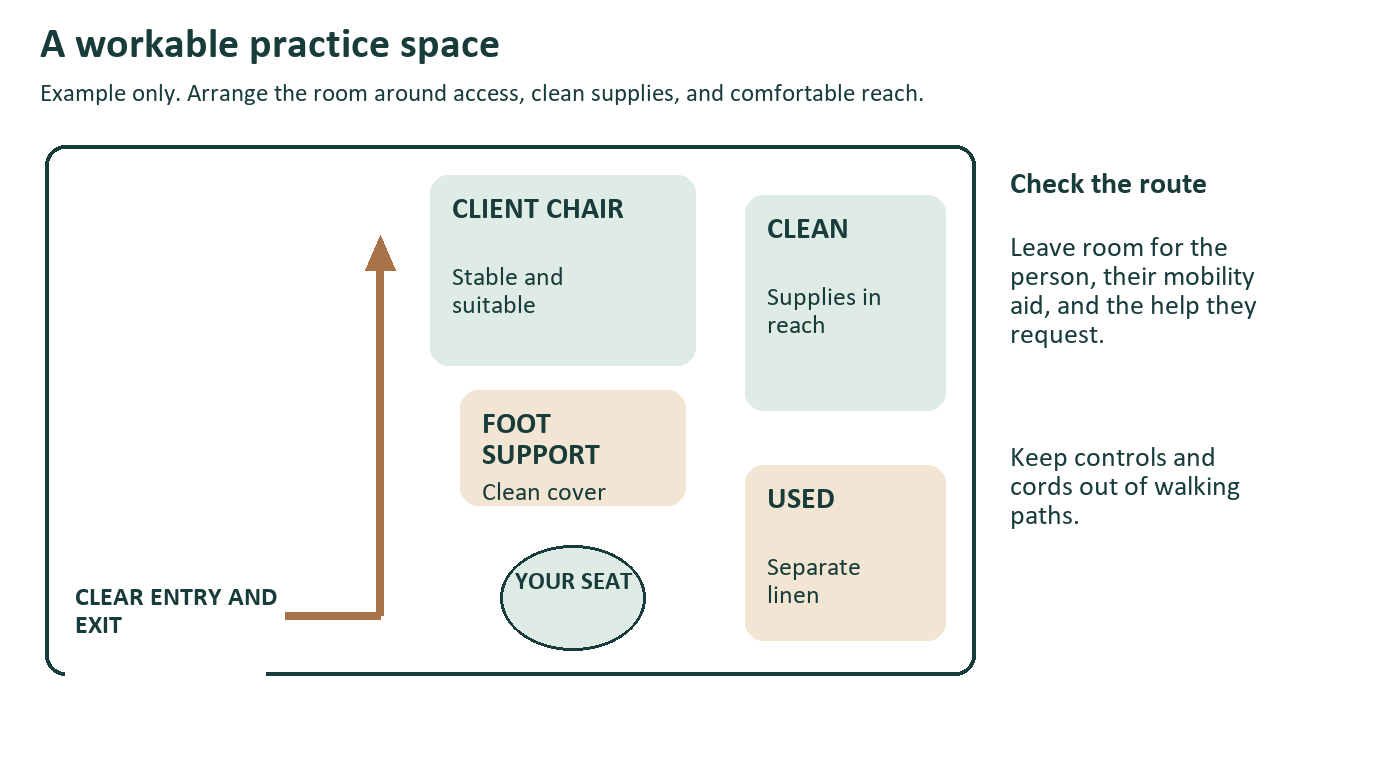
A simple practice room showing a clear entrance, client chair, supported feet, practitioner seat, clean supplies and separate used linen area

Your finished work

  • Demonstrate a workable setup and explain your equipment choices.
  • Adjust seating, supports, lighting, and sound in response to a partner.
  • Show clean hands and comfortable working posture.
  • Submit your own repeatable preparation and reset checklist.

Suggested study time: 40 minutes of lessons and demonstrations, 35 minutes of practice, and 15 minutes for the learning check and reflection. Pause and repeat demonstrations as needed. Complete Section 2 on consent and safety first. This section teaches preparation, not device treatment protocols or assisted-transfer skills.
Lessons

Learning route

Seven short lessons

Lesson Focus and learner action Suggested time
5.1 Walk through Ruth’s preparation and identify personal choices 5 minutes
5.2 Build a beginner kit and check furniture suitability 6 minutes
5.3 Arrange the room and support the client 7 minutes
5.4 Prepare hands and adjust working posture 6 minutes
5.5 Clean and reset the space between people 6 minutes
5.6 Offer warmth and atmosphere with meaningful choice 5 minutes
5.7 Rehearse a repeatable preparation routine 5 minutes

How to use this section

Read or listen to a lesson, watch the suggested demonstration, and try the small activity before moving on. For partner work, explain the exercise and obtain permission. A person can decline any position, support, touch, or recording. Practise setup without reflexology pressure if you have not learned the relevant technique yet.

Ruth’s practice identifies information she supplied. Teaching guidance adds practical instruction and researched safety principles. Practice scenario means an invented learning example, not a client story from Ruth. Spoken teaching scripts are proposed course wording; they are not transcripts of recorded lessons.

Start with an observation

Imagine entering a room for the first time. Where do you put your belongings? Is there a clear place to sit? Can you see the floor? Would you feel comfortable asking to leave the lights on?

Write one thing that helps you feel welcome and one thing that makes a room harder to use. Keep these answers nearby: someone else’s preferences may be different.

Welcome cue: __________________________________________________

Possible barrier: _________________________________________________

Lessons

Lesson 5.1 · Walk through Ruth’s routine

Ruth’s practice

Ruth describes preparing a warmed treatment surface, warm foot cloths, a stone warmer, and red-light mitts and foot devices. She reports placing warm stones inside the hand mitts. She uses a separate clean foot cloth for each client and has a small microwave in her space for warming cloths.

She checks the lighting, starts soft music, runs a small fan, and sometimes sprays peppermint oil before arrival. The lights are brighter when the client enters, then she gradually dims them. Her aim is a serene space that feels deliberately prepared.

Ruth also makes an honest distinction between what she does and what she hopes to do more consistently: she would like to spend more time sitting quietly, meditating, or setting an intention. She does not say that this is already a dependable daily ritual.

Teaching script

“Look around the space before looking at the extras. Can this person enter and settle comfortably? Are the supplies clean and within reach? Can I work without bracing or reaching? Those questions come first.

“Ruth’s room gives us ideas about warmth, sound, and lighting. Each is an invitation we can adapt. The person who loves a warm room may be followed by someone who wants a cool room, no scent, and brighter light. We can prepare carefully and still leave room for choice.

“Preparing yourself can be very ordinary. Finish the previous task, put your phone away, check your hands, and notice whether you are rushing. You do not have to feel perfectly calm to be attentive.”

Watch and notice

Film a doorway-to-chair walkthrough. Show the route, clean supplies, adjustable stool, foot support, and controls before showing decorative details. Identify optional devices without demonstrating their use in this beginner lesson.

Pause activity: Name three preparation steps you can do without buying equipment. Then identify two features of Ruth’s routine that require a preference check or separate device instructions.

Teaching boundary: Heating a cloth does not establish sanitization. Combining stones, mitts, mattress layers, or heat sources is not taught here; compatibility requires the exact manufacturers’ instructions.

Lessons

Lesson 5.2 · Choose the essentials

Teaching script

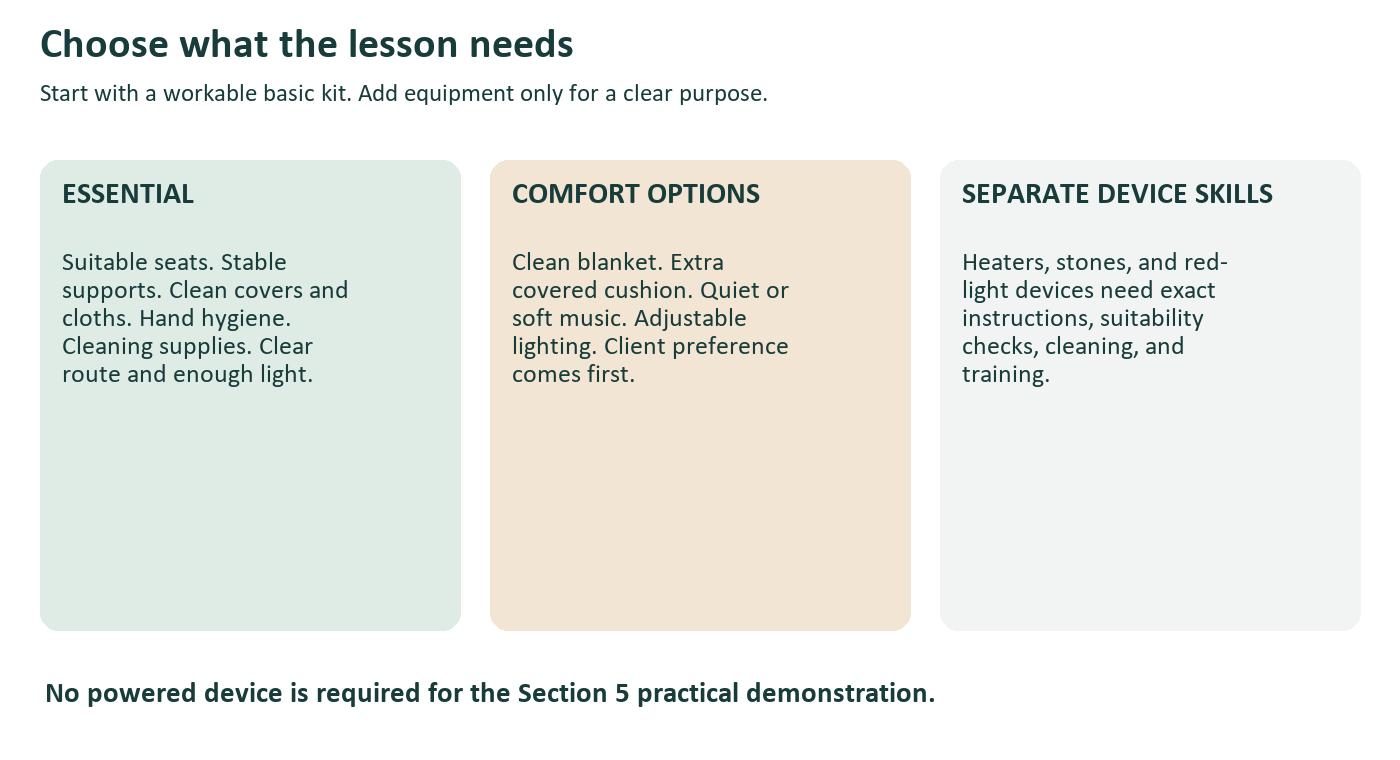
“Begin with what lets both people work comfortably. The client needs stable seating and supported feet. You need a seat that puts your hands near the work without lifting your shoulders. Clean covers and a reliable cleaning routine matter more than a decorative room.

“Check the actual furniture. Its appearance, price, or material does not tell you its safe load. Read the manufacturer’s capacity and instructions, check the frame and locks, and make sure the position works for this person. If you cannot verify suitability, choose something else.”

Category Beginner essentials Optional additions
Seating Stable, suitably rated client chair and practitioner seat; an adjustable practitioner seat is useful Purpose-built recliner or treatment table
Support Stable footrest; clean covered cushions or folded towels that stay in place Dedicated bolsters and arm supports
Hygiene Handwashing access, clean covers and cloths, appropriate cleaning products, separate used-linen container and waste bin Extra storage or a purpose-built towel warmer
Room Clear route, adequate task light, privacy, comfortable temperature Dimmers, music, decorative lights, fan
Comfort Ask preferences; offer a clean blanket if wanted Heated equipment, stones, red-light devices, scent

Ruth’s experience and alternatives

Ruth began with a seated massage chair at a market pop-up. She used foot wipes, a little essential oil, and a warmed neck-and-shoulder wrap, and offered 15- or 30-minute sessions involving the head, hands, and feet. Her comment that the chair became awkward beyond about 30 minutes describes her experience, not a universal limit.

She suggests a zero-gravity lounge as one possible room setup and a quality lounge chair with a footstool when the forward-facing chair does not suit someone. Her current lounger is described as molded steel from Design Within Reach with an added mattress and heat source. These are reported choices, not verified product recommendations.

Try it: Sort your equipment into “needed to practise today,” “useful later,” and “not needed for this lesson.” A warmer is optional even though Ruth considers it valuable in her own routine.

Practice & reference

Equipment check before use

Three equipment groups showing essentials, comfort options, and devices requiring separate training

A practical buying and borrowing check

  • Identify the exact model and find its instructions, rated capacity, and permitted uses. Include the expected load as defined by the manufacturer; do not invent a safety allowance.
  • Inspect joints, feet, upholstery, hinges, cables, and locking mechanisms. Used furniture needs the same checks as new furniture.
  • Check whether the surface and added covers can be cleaned appropriately. A blanket does not repair torn upholstery or make an unstable chair safe.
  • Rehearse entry, position changes, and exit with the unoccupied chair first. Adjust it only as instructed.
  • Check width, seat height, arm placement, foot support, and room to move. A suitable weight rating alone does not establish a good fit.

Low cost alternatives

For learning, a firm, stable household chair and stable footrest may work if their suitability can be verified and the partner is comfortable. Cover cushions with freshly laundered cases. Use a folded towel for a small support adjustment; avoid loose piles that can slip. A regular chair for the practitioner can work if its height allows relaxed shoulders and supported feet.

Do not improvise: stacked boxes as a weight-bearing footrest, unstable chair risers, cushions used to compensate for a broken frame, or unverified furniture for a client’s load.

Before you spend: Write the problem you need to solve. “My shoulders lift while I work” points to changing working height or reach. It does not automatically mean you need a more expensive client chair.

Lessons

Lesson 5.3 · Position for access and comfort

Teaching script

“Ask before moving anything or anyone. ‘What would make it easier for you to get comfortable?’ is a better starting point than deciding what the person can do by looking at them.

“Begin with the position they can use comfortably. Some people prefer upright sitting. Others like a little recline. Support the limb so they do not have to hold it up for you. Then bring yourself close enough to work. Make one small adjustment, ask how it feels, and check again.”

Demonstrate this sequence

  1. Keep the entrance, walking route, and exit clear. Position cables away from travel paths and leave mobility aids accessible.
  2. Explain the chair and offer a choice of suitable positions. Ask what assistance, if any, is wanted. Do not lift or transfer someone without appropriate training and equipment. Remaining in their own chair may be an option.
  3. Ask permission before reclining or placing supports. Follow the chair’s locking and adjustment instructions. Keep fingers, clothing, and supports away from hinges.
  4. Support the lower leg and foot without forcing the knee straight or holding the ankle at an uncomfortable angle. A small clean support may help; remove it if it increases pressure or symptoms.
  5. If reclined, check the head, neck, arms, and comfort behind the knees. Avoid pressing a hard edge into the back of the knee. Do not force a “correct” angle.
  6. Place your seat near the feet, adjust working height, and check that you can reach supplies without twisting.
  7. Ask: “How is your neck? Your knees? Any pressure, pulling, or tingling?” Recheck after settling, after each adjustment, and whenever comfort changes.

Access guidance [3]: Ask the person how best to assist and use suitable equipment. The cited ADA resource concerns medical settings; these are transferable planning principles, not a statement that this room satisfies every legal requirement.

Partner activity: Practise an upright setup and, only if suitable, a gently reclined setup. Your partner chooses the more comfortable arrangement. Write what changed and why. Stop if pain, numbness, dizziness, or distress occurs; return to Section 2’s response guidance.

Practice & reference

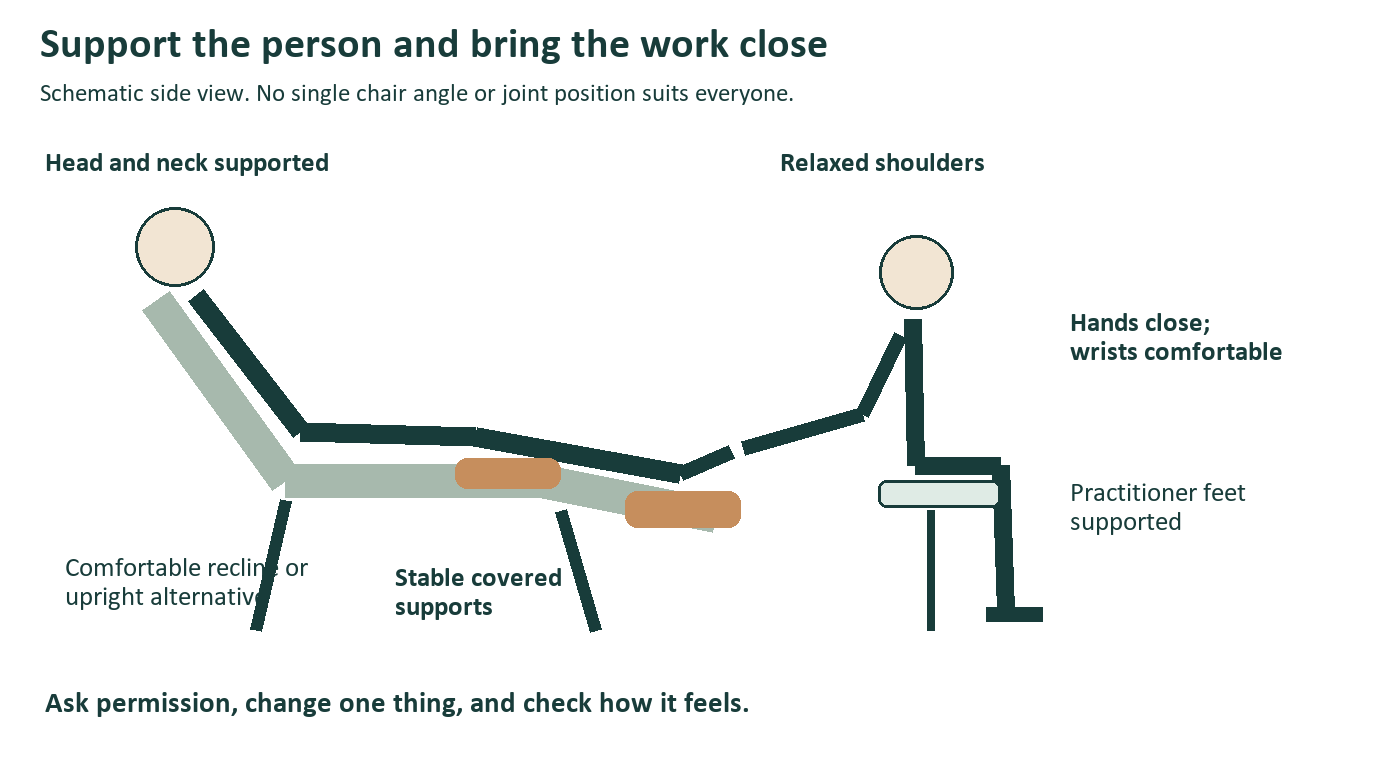
Visual guide to supported positioning

Schematic of a supported client and practitioner with relaxed shoulders, nearby hands and supported feet

Read the picture as a checklist

The picture shows a possible arrangement, not required joint angles or a treatment posture for everyone. Adapt it to the client, your body, and the actual furniture.

  • The client’s body is supported rather than held in position by effort.
  • The practitioner moves the seat and support instead of reaching from far away.
  • Shoulders stay relaxed and wrists stay near a straight, comfortable position.
  • Both people can request a change. Neither person needs to endure discomfort to complete the exercise.

Compare two attempts

Attempt one: Place your seat too far away while the chair is empty. Notice the reach. Do not practise pressure in this posture.

Attempt two: Move your seat closer and adjust the foot support. Rest your hands near the work without applying pressure. Notice whether your shoulders and wrists feel easier.

Learning prompt: Which adjustment helped most: distance, seat height, support height, or client position? There may be more than one useful change.

My first change: __________________________________________________

What my partner reported: __________________________________________

What I changed next: _______________________________________________

Lessons

Lesson 5.4 · Prepare your hands and body

Teaching script

“Before contact, look at your hands as working tools. Nails should be short and smooth enough not to scratch. Remove jewelry that could catch, press into skin, or interfere with cleaning. Check for broken skin, irritation, or anything that would make contact unsafe.

“After cleaning your hands, settle your feet and let your shoulders drop. Open and close your hands gently within a comfortable range. This is a readiness check, not a strength test. If movement hurts, do not push through it.

“During practice, adjust the setup when you notice strain. More effort is not automatically better contact. Pain, tingling, numbness, or weakness are reasons to stop and reassess.”

A short readiness routine

  • Check nails, skin, sleeves, and jewelry. Cover a minor cut with an appropriate waterproof dressing; if contact cannot be kept safe, do not practise. Gloves, when indicated, do not replace hand hygiene.
  • Clean hands before and after each client and after handling used linens or waste. With soap and water, scrub for at least 20 seconds, rinse, and dry. If unavailable, use at least 60% alcohol sanitizer when appropriate; wash visibly dirty hands. [1]
  • Use a suitable moisturizer as part of hand care, allowing it to absorb; avoid transferring unwanted fragrance or product to the client.
  • Check that your feet are supported, shoulders relaxed, elbows near your body, and wrists close to neutral. Adjust your seat before adding effort. General ergonomic principles are adapted from [4].
  • Change position and take short recovery pauses. Build breaks into the schedule rather than waiting for pain. Persistent or recurring symptoms warrant professional assessment.

Ruth’s seating choice

Ruth reports using an adjustable stool with an inflatable seat at the feet, where she spends more time. At the head, she uses a basic stool for shorter periods. She was unsure of the inflatable-seat brand; this course does not identify or recommend a specific model.

Try it: Rehearse two minutes of supported hand placement without pressure. A partner observes whether you lift your shoulders, bend your wrists sharply, or hold the limb in the air. Make one adjustment and repeat. This exercise does not establish readiness for a full workday.

Lessons

Lesson 5.5 · Clean and reset the space

Teaching script

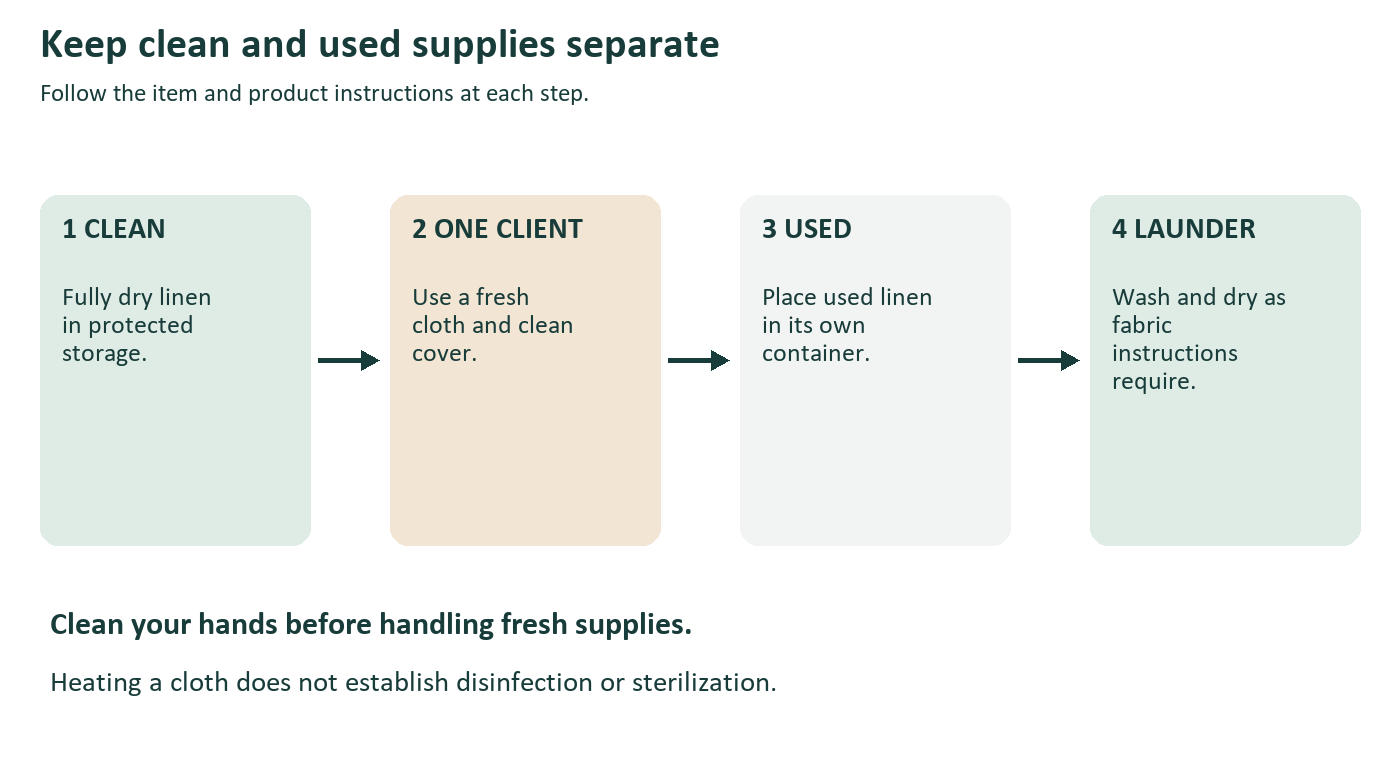
“Set up a clean side and a used side. The clean cloth should be easy to reach without searching through supplies. Once a cloth has touched a client, it goes to the used-linen container and does not return to the clean area.

“Cleaning and disinfecting are different tasks. Remove visible soil and follow the surface and product instructions. When disinfection is required, keep the surface wet for the product’s full labeled contact time. Do not guess a time or mix products.”

A one way linen flow from clean storage to one client to used linen to laundering and back to clean storage

Between clients

  1. Perform hand hygiene as appropriate, collect used linen without shaking it, and place it in its designated container. Dispose of single-use items.
  2. Clean touched surfaces, including chair contact areas, footrest, stool controls, and items handled during the session. Disinfect as required by the product directions and applicable practice rules. Use compatible products; never put a hard-surface disinfectant on skin. [2]
  3. Follow laundry and fabric instructions; dry items fully before returning them to clean storage. Clean reusable covers and devices according to their instructions. Do not reuse an uncleanable shared item.
  4. Replace covers and cloths, replenish supplies, clean your hands, and recheck the route and furniture.

What a warm cloth can and cannot do

A freshly laundered cloth may be offered for comfort or ordinary skin cleansing when appropriate. Warming it in a microwave or warmer does not prove that it is disinfected or sterile. Skin wipes must be intended for skin and used according to their label; never warm packaged wipes unless their manufacturer permits it.

Spot the error: You clean your hands, collect the previous client’s towels, then reach for the next clean cloth. What is missing? Answer: clean your hands again before handling the clean supplies.

Lessons

Lesson 5.6 · Offer warmth and atmosphere

Teaching script

“Ask before adding something the person cannot easily escape. A scent sprayed before arrival is already in the room. Begin fragrance-free and ask about preferences in advance. Silence, a cooler room, or brighter light can be someone’s most comfortable setting.

“Offer one choice at a time: ‘Would you prefer music or quiet?’ ‘Would a blanket help?’ ‘Shall we leave this light on?’ Leave enough light to move safely and observe the area you are working on. Bring it up before the client gets out of the chair.”

Feature Beginner course approach Check during the session
Light Enough for entry, observation, and exit; dim only by agreement Can you see and can the client move safely?
Sound Offer quiet or low-volume audio; keep conversation audible Is this welcome or distracting?
Scent Fragrance-free default; no ambient spray before consent Any headache, irritation, or wish to stop?
Temperature Ask about room temperature; offer a clean blanket Too warm, too cool, or drafty?
Heat devices Optional; exact manual, suitability, consent, monitoring, and training required Remove if uncomfortable or skin changes occur
Red-light devices Separate optional equipment, outside this setup lesson Exact model, instructions, precautions, and cleaning needed

Heat needs a separate decision

For this beginner exercise, use unheated cloths and supports. Heat can burn. Reduced sensation or circulation concerns require particular caution; do not add heat when suitability is uncertain. Do not rely only on whether your own hand finds an item comfortable. Check the device instructions, the client’s ability to report discomfort, and the skin as directed. General precautions are supported by [5] and [6].

There is no universal microwave time, stone temperature, or red-light dose in this course. Microwave heating may be uneven. Do not combine heated stones with light mitts, layer a heating pad beneath a person, or add mattress insulation unless the exact equipment instructions explicitly permit that arrangement. Decorative salt lamps and room design are atmosphere, not evidence of health benefit. Reflexology’s proposed organ-healing effects have not been established. [7]

Lessons

Lesson 5.7 · Rehearse your preparation routine

Teaching script

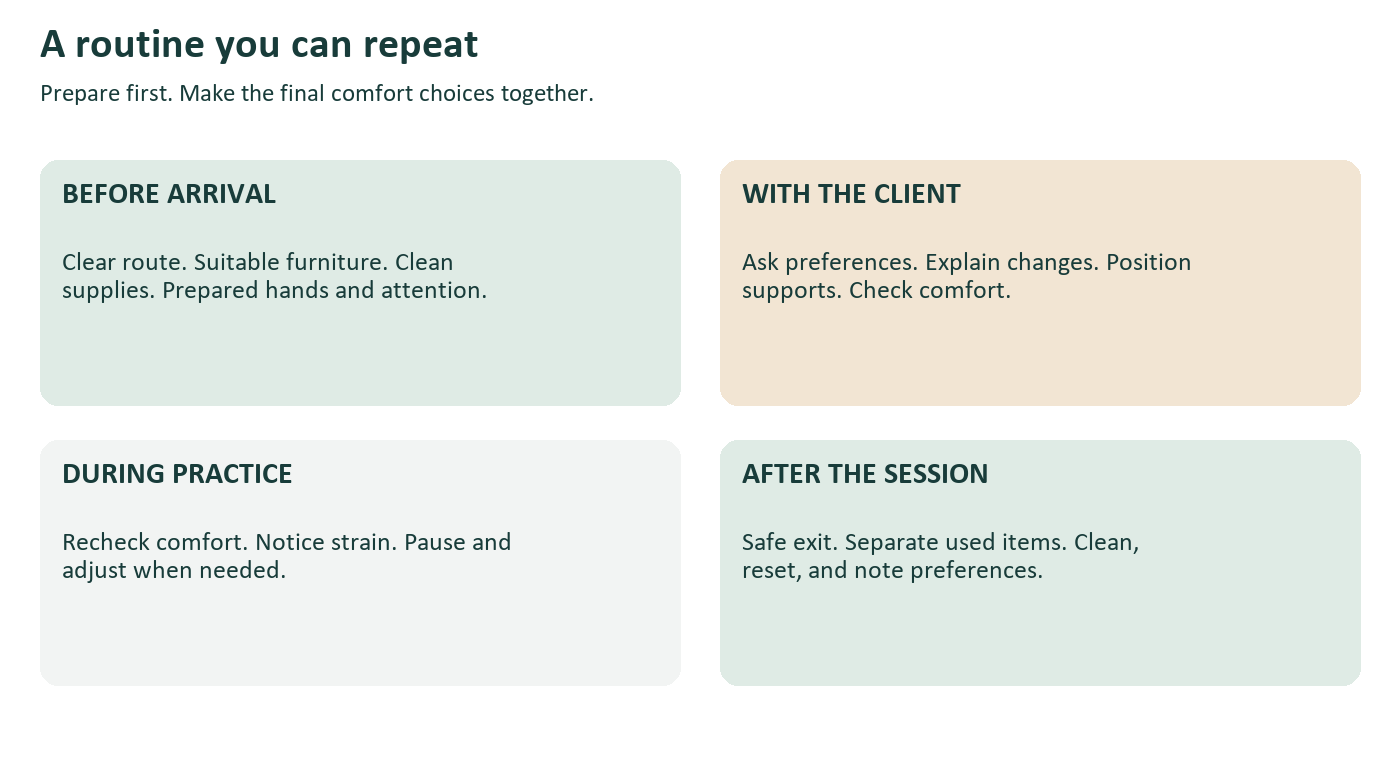
“A useful routine is short enough to repeat and clear enough to catch a missed step. Prepare the room, prepare yourself, and then prepare with the client. Leave the preference decisions open until you have heard their answer.

“Before you invite someone in, stop for a moment. Can you walk the route? Are the clean items ready? Is your chair at a usable height? Now check yourself: hands, shoulders, attention. You are ready to welcome the person and make the final adjustments together.”

Suggested personal pause

This 60-second practice is an added teaching suggestion, not a claim about Ruth’s established routine. Sit or stand comfortably. Let your hands rest. Notice your feet and take a few ordinary, unforced breaths. Choose a simple intention, such as “I will listen and adjust.” Skip breathing cues or closed eyes if they feel uncomfortable. Meditation is optional.

Preparation sequence before arrival, with the client, during practice and after the session

Rehearsal

Set a five-minute timer for a dry run without a client. Use the next page’s checklist, then walk out and return as if visiting for the first time. Time pressure must never shorten cleaning contact times or replace equipment checks; actual preparation may take longer.

Invite a partner to choose one change: quieter sound, upright sitting, different support, or brighter light. Make the change and explain what you checked. Finish by resetting the space.

Reflection: What did you forget? Where will you put the checklist so it helps next time? Keep the routine consistent while allowing client preferences to vary.

Practice & reference

My repeatable preparation checklist

Name ________________________ Date __________ Space __________________

Mark each item when completed. Write N/A where appropriate. Keep this sheet where you prepare; adapt it to the actual equipment and practice requirements.

Before arrival

  • Confirm access needs and seating preferences in advance when possible.
  • Clear the entrance, route, exit, and space around the chair; manage cords.
  • Check furniture condition, capacity information, locks, and support stability.
  • Complete cleaning and required disinfection, including full contact time.
  • Fit fresh covers; prepare separate clean cloths and a used-linen container.
  • Place supplies within reach; check privacy, light, temperature, and ventilation.
  • Begin fragrance-free; keep optional devices off unless separately planned.
  • Check hands, nails, jewelry, and clothing; clean hands.
  • Adjust my seat and take a brief attention pause.

With the client

  • Explain the setup; ask what assistance and position they prefer.
  • Obtain permission before adjusting the chair, placing supports, or touching.
  • Check head, neck, arms, knees, lower legs, and feet as relevant.
  • Agree on light, sound, blanket, and how they will request a change.
  • Confirm both people can work comfortably and the client can exit safely.

During and after

  • Recheck comfort after settling and changes; stop for concerning symptoms.
  • Pause and reposition myself when I notice strain.
  • Raise lighting for exit; allow time and ask what help is wanted.
  • Separate used items, clean and reset, and perform hand hygiene.
  • Record relevant preferences appropriately for next time.

My equipment-specific checks: ________________________________________


One change for next practice: _________________________________________

Practice & reference

Workbook Plan a workable setup

Start with what you have

Item or need My choice and verification Change needed
Client seating
Foot and body supports
Practitioner seat
Cleaning and linen storage
Entrance and exit
Light and temperature

Sketch the space

Draw the client seat, foot support, practitioner seat, clean supplies, and used-linen area. Add an arrow showing entry and exit. Mark possible obstacles and the locations of controls. This is a practice sketch, not a building-compliance plan.


Explain your choices

What can your partner change without feeling that they are disrupting your routine?


What item can you postpone buying, and why?


What evidence tells you that your chosen chair is suitable?


Practice & reference

Workbook Make an adjustment

These scenarios are invented for practice. Ruth offered the lounge-and-footstool option, but did not supply a complete before-and-after client case.

Scenario A The chair does not fit

A partner says the forward-facing massage chair feels narrow and difficult to enter. A second, suitably rated lounge chair is available.

Your task: Ask what position they prefer. Check the alternative’s capacity, width, access, and stability. Set up a stable footrest and your own seat. If no suitable arrangement is available, stop rather than improvise an unsafe one.

What did you ask? __________________________________________________

What changed? ____________________________________________________

What did your partner report? ________________________________________

Scenario B The atmosphere is uncomfortable

A partner asks for brighter lights and says fragrance gives them headaches. You had planned music and dim lighting.

Your task: Leave fragrance out, change the light, and offer quiet. If scent is already present and cannot be cleared sufficiently, offer a suitable alternative space or another time. Do not ask them to tolerate it.

My words to the partner: _____________________________________________

Scenario C Your hands begin to strain

You notice raised shoulders and a sharply bent wrist while reaching toward the foot. No symptoms were present before practice.

Your task: Pause. Move closer, adjust seat or support height, and resume only if comfortable. Stop if pain, tingling, numbness, or weakness occurs or persists.

My first adjustment: _________________________________________________

Scenario D Warmth is requested but sensation is reduced

A partner requests warm stones and mentions that their feet sometimes feel numb.

Your task: Leave heat out of this beginner practice. Return to Section 2’s suitability and referral process. Offer an unheated comfort option if appropriate; do not test heat on reduced-sensation skin.

My explanation: ___________________________________________________

Practice & reference

Learning check

Choose an answer before reading the explanations on the next page.

  1. Which beginner kit is most suitable? A: Red-light mitts and a stone warmer. B: Suitable seating, stable supports, clean supplies, hand hygiene, and a clear route. C: Any recliner covered by a blanket.

  2. A used lounge looks sturdy but has no identifiable model or capacity. What should you do before using it for a client?

  3. Ruth says her market massage-chair sessions were generally 15 or 30 minutes. Does that establish a universal maximum duration for every chair and client?

  4. True or false: A microwaved cloth can be described as disinfected because it is warm.

  5. You have just put used linens in a container. What should happen before handling the next client’s clean supplies?

  6. A client wants to remain upright and keep the lights on. How should you respond?

  7. Your shoulders lift while reaching for the foot. Name two setup adjustments to try before continuing.

  8. A partner reports reduced heat sensation. Should you add a heated stone if it feels comfortable in your own hand?

  9. When should you ask about scent? A: After spraying it. B: Before adding it, ideally before arrival. C: Only if the person complains.

  10. A client needs help transferring. What should determine whether and how you assist?

  11. True or false: A piece of furniture’s weight rating alone proves it is accessible and comfortable for every person within that range.

  12. Name the four moments covered by your preparation checklist.

Reflect

Which answer changed how you would prepare a space?


What will you practise again before working with a partner?


Practice & reference

Answers and explanations

  1. B. These items support the basic learning task. Atmosphere and powered devices are optional.

  2. Find reliable manufacturer information and inspect condition, locking mechanisms, and fit. If suitability cannot be verified, select different seating. A photograph or seller’s reassurance is not a capacity specification.

  3. No. That is Ruth’s reported experience. Comfort, furniture instructions, session scope, and the individual determine what is workable.

  4. False. Warmth is not a validated cleaning or disinfection process. Start with a clean cloth and follow an appropriate reuse and laundry routine.

  5. Perform hand hygiene, then handle clean supplies without contaminating them.

  6. Accommodate those preferences if the setup remains safe. Ask what supports would help and recheck comfort. Reclining and dimness are not requirements.

  7. Move the practitioner seat closer; adjust seat height or foot-support height. Reassess wrists, shoulders, and reach before continuing. Do not work through symptoms.

  8. No. Your own sensation does not establish their safety. Omit heat and follow the suitability process.

  9. B. Starting fragrance-free preserves a meaningful choice. Ambient scent can linger after a client declines it.

  10. Ask the person what assistance they need and prefer. Use appropriate training, equipment, and a planned safe approach. Do not improvise a lift or assume that a companion will provide one.

  11. False. Width, height, stability, entry, exit, supports, and the person’s preferences also matter.

  12. Before arrival, with the client, during practice, and after the session.

Suggested learning threshold

Aim for at least 10 of 12 correct, then review every missed item. Any unsafe answer about furniture suitability, hygiene, heat, or transfers must be corrected before the practical demonstration. This is a proposed course assessment, not a licensing or certification standard.

Teach back: Explain to a partner why an ordinary, well-prepared setup can meet this lesson’s goal. Include an example of how you would change it for someone else.

Practice & reference

Practical demonstration

Your assignment

Prepare a space for a consenting adult practice partner. Demonstrate setup and adjustment only; no powered devices, heat, or pressure techniques are required. Spend about 8 to 10 minutes showing the arrangement and explaining your choices, then complete a reset.

Show the entrance and exit, furniture checks, clean and used supply locations, hand preparation, client supports, and practitioner position. Ask about preferences and respond to one requested change. Explain how your checklist helps you repeat the routine.

You may demonstrate live or use an agreed recording format. Obtain separate permission for recording, keep private information out of view, and follow the course’s storage rules. A narrated photo sequence or observer-supported demonstration can be considered where it meets the same learning criteria.

Criterion Observable evidence Score
Equipment Identifies suitable furniture, capacity evidence, stability, and supports /2
Access Clear route; asks about assistance; explains safe exit /2
Hygiene Clean hands and surfaces; separates clean and used supplies /2
Client comfort Permission before changes; supports body; asks for feedback /2
Practitioner Supported feet, relaxed shoulders, comfortable reach and wrists /2
Choice Adapts light, sound, position, and temperature without pressure /2
Repeatability Uses a complete checklist and shows a reset /2

Scoring: 0 = absent or unsafe; 1 = partly demonstrated or needs prompting; 2 = independently demonstrated and explained. Suggested pass: 12/14 with no zero in equipment, access, hygiene, or client comfort, and no unresolved safety issue. Rehearse and resubmit affected steps when needed.

Stop and correct immediately: unstable or unsuitable seating; blocked exit; unsafe transfer attempt; contaminated supplies used as clean; continuing despite pain; or an unassessed heat application. Do not wait until the end to give safety feedback.

Observer __________________________ Date __________ Score ______ /14

One strength _____________________________________________________

One action before next practice _______________________________________

Production & sources

Instructor demonstration and filming guide

Keep each demonstration visible

Scene What the camera should show Learner cue
Doorway tour Route, seating, footrest, supplies and controls Pause and identify one possible barrier
Essential kit Basic items laid out; optional devices apart Choose what is needed for today
Furniture check Model information and locks without exposing private details Explain what evidence you need
Positioning Wide side view followed by close views of supports Ask before each change
Hand preparation Nails, jewelry removal, complete handwashing sequence Follow the full hygiene routine
Posture change Empty-chair reach example, then supported practice Move closer and reassess
Reset Used linen separation and surface cleaning Do not edit out required contact time without explaining it
Personal pause A simple unforced pause before welcoming the partner Choose your own repeatable cue

Caption every video, provide a transcript, and say aloud what the viewer should notice. Avoid background music under essential instructions when it reduces clarity. Use steady wide views so learners can see the relationship between the two people. Show the final arrangement after each adjustment.

Ruth’s contribution

Invite Ruth to demonstrate her own room and identify which steps are routine and which are optional. Preserve her honesty about personal preparation. Ask her to show a real adjustment only if she can describe it accurately and protect the client’s privacy; otherwise use the labeled practice scenarios.

Production notes

Verify exact furniture and device models before filming demonstrations involving them. The inflatable-seat brand is uncertain. The warm-stone and red-light-mitt combination has not been verified and is not a beginner instruction. Couples sessions and sound therapy remain outside this section.

The supplied website screenshot is a visual reference for warm lighting and atmosphere. It is not an accessibility assessment, equipment specification, or proof of treatment effects. Use Ruth’s actual room footage with appropriate rights and permissions for the final course.

Production & sources

Sources and teaching boundaries

Research checked September 24 2026. The numbered references support the added guidance indicated in the lessons. General healthcare and workplace guidance is adapted conservatively; it does not establish a reflexology-specific protocol or certify a room’s compliance.

[1] CDC Hand hygiene. Handwashing sequence and sanitizer guidance. Applied in Lesson 5.4 and the checklist. CDC About Handwashing

[2] CDC Facility cleaning. Cleaning, disinfection, product directions, and wet contact time. Applied in Lesson 5.5; local practice rules and surface instructions still apply. CDC When and How to Clean and Disinfect a Facility

[3] United States Department of Justice. Asking about assistance and planning accessible equipment and transfers. This source concerns medical care; the course borrows practical access principles without claiming legal equivalence. ADA Access to Medical Care for Individuals with Mobility Disabilities

[4] OSHA Ergonomic positions. General neutral-position principles adapted for a seated practice exercise. This is computer-workstation guidance, not validation of a reflexology technique. OSHA Computer Workstations Positions

[5] Gloucestershire Hospitals NHS Foundation Trust. Gentle warmth, protective layers where appropriate, and skin monitoring. No injury-treatment timing or heat prescription is imported into this course. NHS Ice and Heat Treatment

[6] South West Yorkshire Partnership NHS Foundation Trust. Heat precautions, including reduced sensation and burn risk. NHS Ice and Heat Therapy

[7] National Center for Complementary and Integrative Health. Reflexology overview and limits of evidence for claimed effects on other body parts. NCCIH Reflexology

Primary course source: Ruth’s spoken account supplied with the Section 5 request on September 24 2026. Her equipment choices, market sessions, atmosphere, and inconsistent personal pause are attributed as her report. The lesson scripts, exercises, diagrams, checklist, and assessment are added teaching material. Original diagrams are schematic and are not furniture plans or manufacturer instructions.

A note for this section

Review workspace

Where your comments live

Connect to the website to share notes with each other. On a static host, use this browser and export your comments to share them.

The access code is in the separate upload guide. Everyone with it can read, edit and resolve review notes.


Device comments are kept in this browser, not sent to anyone. Export a backup before clearing browser data or switching devices.