
REFLEXOLOGY REVISITED · COURSE REVIEW EDITION
← All chapters

Chapter 04 / 12 · 8 lessons

Touch, state & evidence

Explore what we notice, what people report and what the evidence can tell us.

Review marks stay on this device.

Lessons

Chapter overview

Reflexology with Ruth Section 4

Complete written teaching draft • September 24 2026

This section helps you understand what touch can feel like, how sensory information reaches the nervous system, and how to speak honestly about a client's response. You will learn with short explanations, simple maps, gentle experiments, and realistic conversations. You do not need to memorize a crowded point chart to begin.

Our central practice is to notice carefully, ask the person, and adapt. A meaningful experience can be described without guessing what happened inside an organ.

Audience and scope: Adult beginners who have completed Section 2 on consent and safety and Section 3 on foot orientation. These lessons introduce sensory awareness and map literacy. They do not qualify learners to diagnose, treat disease, practice a complete foot-zoning system, or deliver professional Dien Chan protocols.

How to use this package: Watch or read a lesson, pause for its activity, and complete its quick check. Use the visual cards beside your practice space. Optional partner exercises require ongoing consent; observation-only and self-practice alternatives are always available.

Supplies: Workbook, pencil, towel, chair, foot model or your own foot, mirror, and clean hands. Facial tools are optional objects for identification in this section. No purchase is required.

About the teaching voice: The spoken scripts are proposed wording for Ruth, not quotations or new claims about her qualifications. The comfort exercises and original visual cards were developed for this draft. They are not Quanta or Dien Chan protocols. Research and tradition are identified separately throughout.
Lessons

Your learning route

By the end, you should be able to explain a simple sensory pathway; distinguish observation, report, theory, and research; avoid inferring brainwaves or organ function from behavior; choose a comfortable beginner exercise; and describe when more training or medical assessment is needed.

Lesson Focus Guided time
1 What touch tells the nervous system 10 minutes
2 State comfort and individual differences 10 minutes
3 Four kinds of statements 12 minutes
4 What research can and cannot tell us 12 minutes
5 Foot zoning and the organ connection question 10 minutes
6 Facial reflexology without the overwhelm 12 minutes
7 Use a quick map and adapt 14 minutes
8 Explain your approach to a client 10 minutes

The 90 guided minutes include demonstrations and short pauses, not 90 minutes of continuous narration. Add 45 minutes of practice, 25 minutes of workbook work, and 20 minutes for the learning check: approximately three hours total. These are planning estimates, not accredited hours. For self-paced delivery, divide each lesson into two to four short clips.

The small-step approach: One area. One comfortable form of contact. One question. One factual note. Add detail when it serves the learner or client, rather than because a chart contains more points.

Before any practice: Confirm the person wants touch, agrees to the area, and can give feedback. Do not practice over injured, broken, infected, inflamed, or newly painful skin. For altered sensation, unexplained swelling, medical complexity, or recent procedures, use the observation-only route until appropriate assessment and guidance are available. Do not change a person's medical advice. [11]

Lessons

Lesson 1 · What touch tells the nervous system

Outcome: Explain sensation without claiming a direct foot-to-organ connection.

Spoken teaching script

“When you place a hand on a foot, you are making contact with skin and the tissues beneath it. Sensory receptors respond to different kinds of input, including pressure, movement, temperature, and potentially harmful stimulation. Nerves carry information toward the central nervous system: the spinal cord and brain. Sensation is what the person experiences after that information is processed. [1]

“Let us use a simple example. The same light contact might feel soothing to one person and ticklish to another. Our job is not to decide which response is correct. Our job is to listen and adjust.

“Three useful words are exteroception, proprioception, and interoception. Exteroception concerns information from outside the body, such as contact with the skin. Proprioception concerns body position and movement. Interoception concerns signals from within the body, such as noticing a heartbeat or internal fullness. We do not need to test these systems in a beginner session. The words help us describe different experiences. [1]

“A reflexology map adds a traditional interpretation to a location. It does not replace this sensory anatomy. We can learn both, provided we name which one we are discussing.”

Try and notice

If comfortable, rest your own hand lightly on your opposite forearm for ten seconds. Remove it. Repeat with a towel between hand and skin. Either version may feel more pleasant, less pleasant, or no different. Skip contact if it is uncomfortable.

Write one sensory description: “soft,” “warm,” “ticklish,” “barely noticeable,” or your own words. Then write one preference. Do not use this experiment to establish a mechanism or a health benefit.

Quick check: “My client noticed warmth” describes a client report. It does not demonstrate that circulation changed in a mapped organ.

Practice & reference

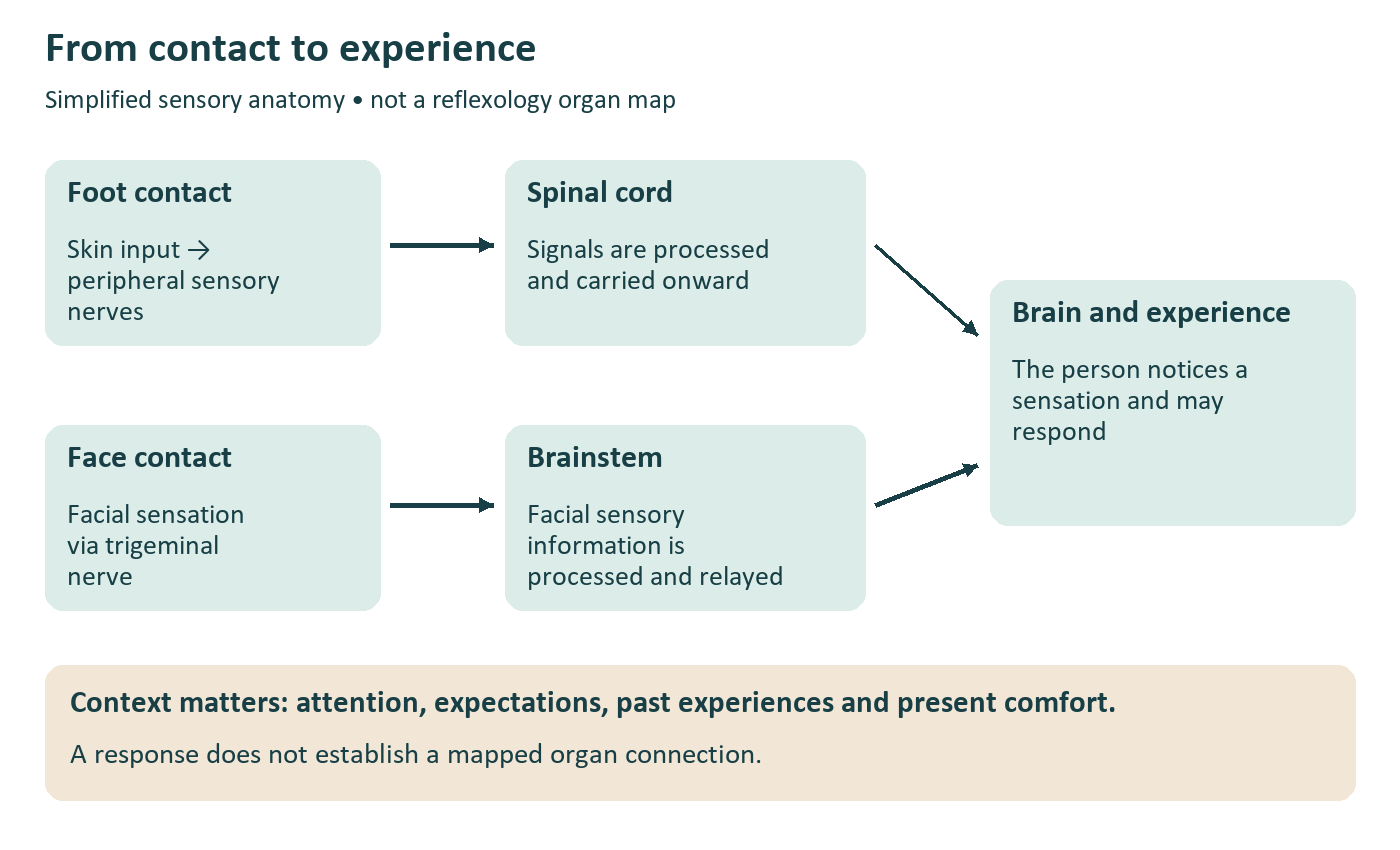
Visual 1 From contact to experience

Simplified sensory pathways from foot and face toward the central nervous system, with context influencing experience

Read the arrows: Foot sensation travels through peripheral nerves toward the spinal cord and brain. Much facial sensation travels through the trigeminal nerve toward the brainstem and brain. This is a simplified teaching picture, not a complete wiring diagram. [1, 8]

There is no line in this figure from a “kidney point” directly to a kidney. General nervous-system connections do not establish the specific correspondences proposed by a reflexology chart.

Point and explain: Choose either starting place. Trace the pathway with a finger, then explain it in one sentence without using the words “unblocks,” “detoxifies,” or “resets.”

Example: “Touch provides sensory information, and the person experiences that information in the context of how they are feeling.”

Lessons

Lesson 2 · State comfort and individual differences

Outcome: Respond to comfort and alertness without diagnosing a nervous-system state.

Spoken teaching script

“In this course, state means a person's present experience of comfort, alertness, and readiness to engage. It is a useful conversation word, not a clinical diagnosis.

“The autonomic nervous system helps regulate functions such as heart activity and digestion. Its sympathetic and parasympathetic divisions have different and sometimes complementary roles. The familiar phrases ‘fight or flight’ and ‘rest and digest’ are introductory shorthand. They are not two whole-body settings we can read from someone's face. [2]

“Someone may become quieter during a session. That invites a check-in. It does not prove that we activated their vagus nerve, lowered cortisol, or shifted them into a particular brainwave pattern. EEG records brain electrical activity using electrodes. Looking peaceful is not an EEG measurement. [3]

“Pain is also an individual sensory and emotional experience. Attention, context, and previous experiences can influence it. A painful spot is not proof of an organ problem, and pushing harder is not a way to verify a map. Respect the person's report. [4]

“Offer choice: lighter contact, a different area, stillness, or stopping. A person can remain talkative and enjoy the session. They can remain quiet and dislike it. Ask rather than perform an interpretation for them.”

Demonstration and pause

Show two acted scenes: one person talks happily; another closes their eyes but says the contact is too much. Freeze the scene before the practitioner responds. Learners choose a question.

Useful question: “How is this contact for you? We can change it or stop.”

Avoid: “You're finally in parasympathetic mode.” Also avoid labels such as “dorsal shutdown” or “trauma release” based on stillness, tears, or yawning.

Quick check: If the client says “unchanged,” record unchanged. Do not increase intensity to obtain a visible response.

Lessons

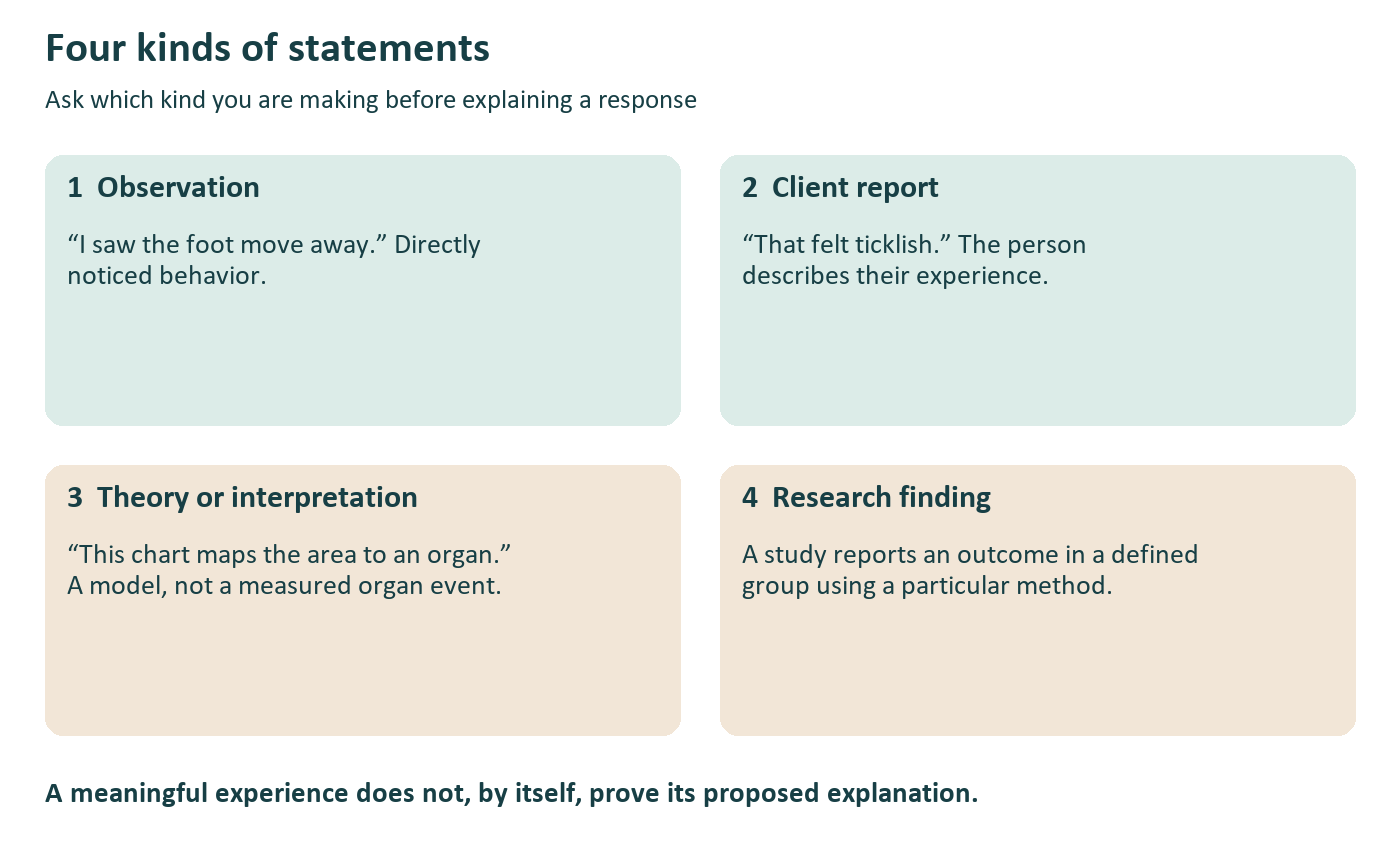
Lesson 3 · Four kinds of statements

Outcome: Keep what happened separate from what might explain it.

Spoken teaching script

“An observation is something you directly notice: the person moved their foot, opened their eyes, or said a sentence. A client report tells you about their experience: ‘That feels sharp’ or ‘I feel more settled.’ Their report matters even when you cannot observe the sensation.

“A theory or interpretation proposes an explanation. ‘This map associates that area with the stomach’ identifies a traditional model. ‘The stomach has released tension’ makes an additional claim about an internal event. Neither follows simply from a gurgle.

“A research finding comes from systematic investigation. Ask who or what was studied, what methods were used, and whether there was a comparison group. ‘A study found a difference in a symptom score’ is research language. ‘My last three clients loved this’ is useful feedback, but it is not a controlled study.

“These categories can appear together. Good notes keep them visibly separate. We can say what we saw, quote what the person said, and leave the cause uncertain.”

Demonstration

Read this fictional note: “Worked kidney zone. Client sighed; blockage cleared.” Cross out the final inference and replace the note with: “During light contact at the plantar midfoot, client sighed and said, ‘That feels comfortable.’ Pressure unchanged at client's request. Cause of sigh not determined.”

If a traditional label is useful, add it separately with the chart name and edition. Do not use a chart label instead of an anatomical location.

Pause and sort: “I saw a toe move.” “The client said their toes tingled.” “Energy moved.” “A trial reported a change in symptoms.” Identify all four before looking at the next page.

Answer: Observation; client report; interpretation; research claim that still needs a source and details.

Practice & reference

Visual 2 Keep four kinds of evidence distinct

Four labeled examples showing observation, client report, theory and research finding

The useful distinction: A report can be accurate about someone's experience without proving a theory about its cause. Research may include client reports as measured outcomes; that does not make all client feedback a research study.

Mini challenge

Classify each statement and revise any overclaim.

  • “I counted three yawns in five minutes.”
  • “They said, ‘I feel sleepy.’”
  • “Yawning means toxins are leaving.”
  • “This article studied sleep ratings after a course of sessions.”

The first is observation; the second is report. The third is an unsupported causal interpretation. Replace it with the observation and ask how the person feels. The fourth describes research only if the article actually did that; inspect its population, comparator, results, and limitations before drawing a conclusion.

Practice phrase: “That is what we noticed. We do not know from this session alone why it happened.”

Lessons

Lesson 4 · Read research without losing curiosity

Outcome: Explain possible benefits and uncertainty in the same conversation.

Spoken teaching script

“Research asks a more specific question than ‘Does reflexology work?’ Work for whom, for which outcome, compared with what, and for how long?

“NCCIH describes reflexology's proposed links between foot or hand points and other body areas as unproven. That does not mean no one can enjoy a session. It means enjoyment or a symptom change does not establish the mapped explanation. [5]

“Some research and clinical guidance address symptom support in particular settings. NCCIH summarizes oncology guidance in which reflexology may be offered for selected symptoms, with varying evidence quality and recommendation strength. This is not evidence that reflexology treats cancer, and it is not a beginner treatment plan. [6]

“When we read a promising result, we ask whether it applies to our client, technique, and goal. Evidence about a foot protocol does not automatically transfer to a facial roller, another map, or a different condition.”

Six questions for every headline

  • Who participated, and how many completed the study?
  • What exactly was delivered, by whom, and how often?
  • What did the comparison group receive?
  • What changed, by how much, and for how long?
  • Were expectations, missing data, and adverse events addressed?
  • What did the study not test?

Study lab: Wyatt and colleagues' 2012 randomized trial included reflexology, lay foot manipulation, and conventional-care groups in women with advanced breast cancer. Read the abstract and identify outcomes that improved and those that did not. Do not describe all 385 participants as belonging to the three main randomized groups; the abstract lists 95, 95, and 96 in those groups. [7]

Teaching answer: The report describes improved physical functioning versus conventional care and reduced dyspnea (shortness of breath) versus comparison groups, but not significant differences in every outcome. It did not establish a kidney flush, prove organ-map anatomy, or test this course's facial exercises. [7]

Practice & reference

Research vocabulary you can use

Anecdote: An account of one or more experiences. Useful for generating questions and understanding preferences; insufficient by itself to establish cause.

Randomized trial: Participants are assigned by chance to study groups. This helps reduce some differences between groups, but does not remove every source of bias.

Comparator: What another group receives. Waiting, usual care, attention, and another form of touch answer different questions. A pleasant-touch comparison may itself affect symptoms.

Blinding: Keeping people unaware of group assignment where possible. Hands-on interventions can make this difficult. A study should explain what was and was not blinded.

Systematic review: A structured synthesis of available studies. Its conclusions depend on the quality and relevance of those studies; a long reference list alone does not establish certainty.

Statistical versus practical importance: A difference can meet a statistical criterion yet be too small or short-lived to matter much to a client. Look for effect size, uncertainty, and follow-up.

The source ladder exercise

Give learners three source types: a tool seller's product page, a school's demonstration, and a clinical study. Ask what each can reasonably establish.

Answer: A product page can identify a tool and its stated intended use. A school can explain its own teaching method. A clinical study can contribute evidence about the outcomes it actually measured. None should be silently substituted for the others.

Instructor prompt: “What additional information would make your conclusion narrower and more accurate?”

For deeper study, start with NCCIH's linked research-literacy resources and read the actual study before repeating a headline. [5] This section is a targeted educational review of the cited material, not an exhaustive systematic review of reflexology or Dien Chan.

Lessons

Lesson 5 · Foot zoning and the organ question

Outcome: Discuss a response during mapped work without diagnosing through the foot.

Spoken teaching script

“Reflexology and foot-zoning approaches may organize contact using different maps and sequences. We should name the method and chart we are discussing. Working on a place labeled ‘kidney’ does not mean we are touching a kidney, measuring kidney function, or demonstrating a dedicated nerve connection.

“Imagine a client sighs as we contact a mapped area. We know when the sigh occurred. We can ask what the contact felt like. We cannot conclude that the mapped organ caused the sigh, or that the organ changed because of our contact.

“A response occurring after touch is a timing relationship. It is not, on its own, proof of cause. Position, pressure, conversation, expectation, and ordinary changes over time can all complicate interpretation.

“Use your map to organize learning. Use the client's feedback to guide comfort. Use medical assessment for medical concerns.”

The kidney flush example

The kidneys filter blood and regulate water, salts, and other substances. A foot session has not been established as a way to flush the kidneys. Nor does a tender mapped area diagnose kidney disease. [5, 9]

Client: “Can you flush my kidneys?”

Practitioner: “Some reflexology traditions use that phrase for a sequence. I can offer a comfort-focused session, but I can't assess or flush your kidneys through your feet. Are you asking about general relaxation, or are you having symptoms that need medical attention?”

Fever or chills with painful urination or pain in the back or side calls for prompt medical care, not a reflexology routine. Severe illness, confusion, or breathing difficulty warrants emergency help. Do not prescribe extra water as a detox measure; some people have medical fluid restrictions. [10]

Quick check: What evidence would demonstrate kidney function? Appropriate clinical assessment and tests, not tenderness on a map or a post-session bathroom visit.

Lessons

Lesson 6 · Facial reflexology without the overwhelm

Outcome: Distinguish facial sensory anatomy, Dien Chan maps, and introductory comfort practice.

Spoken teaching script

“The face is sensitive, and it deserves its own permission and pace. Much facial sensation is carried by the trigeminal nerve. Its three main divisions are often introduced as ophthalmic, maxillary, and mandibular. These are anatomical nerve divisions, not three organ zones. [8]

“A numbered Dien Chan chart presents points and correspondences within that method. It should not be described as hundreds of individually mapped anatomical nerve endings. The nervous system and the traditional point system are different kinds of maps.

“Quanta's public curriculum introduces foundations and diagrams before more precise point location and advanced work. Its materials include small visual references and tools. We can use a similarly manageable learning rhythm while creating our own course content. [12]

“For this introduction, learn broad surface areas: forehead, cheek, and outer jaw. Learn whether the person wants facial contact at all. We are not assigning organs to those areas or teaching exact bqc-point prescriptions here.

“If precise Dien Chan work interests you, take it further through the method's training, chart references, and feedback on technique. Precision is a learnable skill. We can respect it without making it the entry requirement for every learner.”

Instructor demonstration

Use a mirror or facial model. Point above the brows, to the fleshy outer cheek, and to the outer lower jaw. Do not press the eye, eyelid, lips, nostrils, or throat. First identify regions without contact. Then demonstrate the optional hand-contact exercise on Card C on your own intact skin.

Quick check: A point chart and a trigeminal nerve diagram may both show a face. They do not show the same information.

Practice & reference

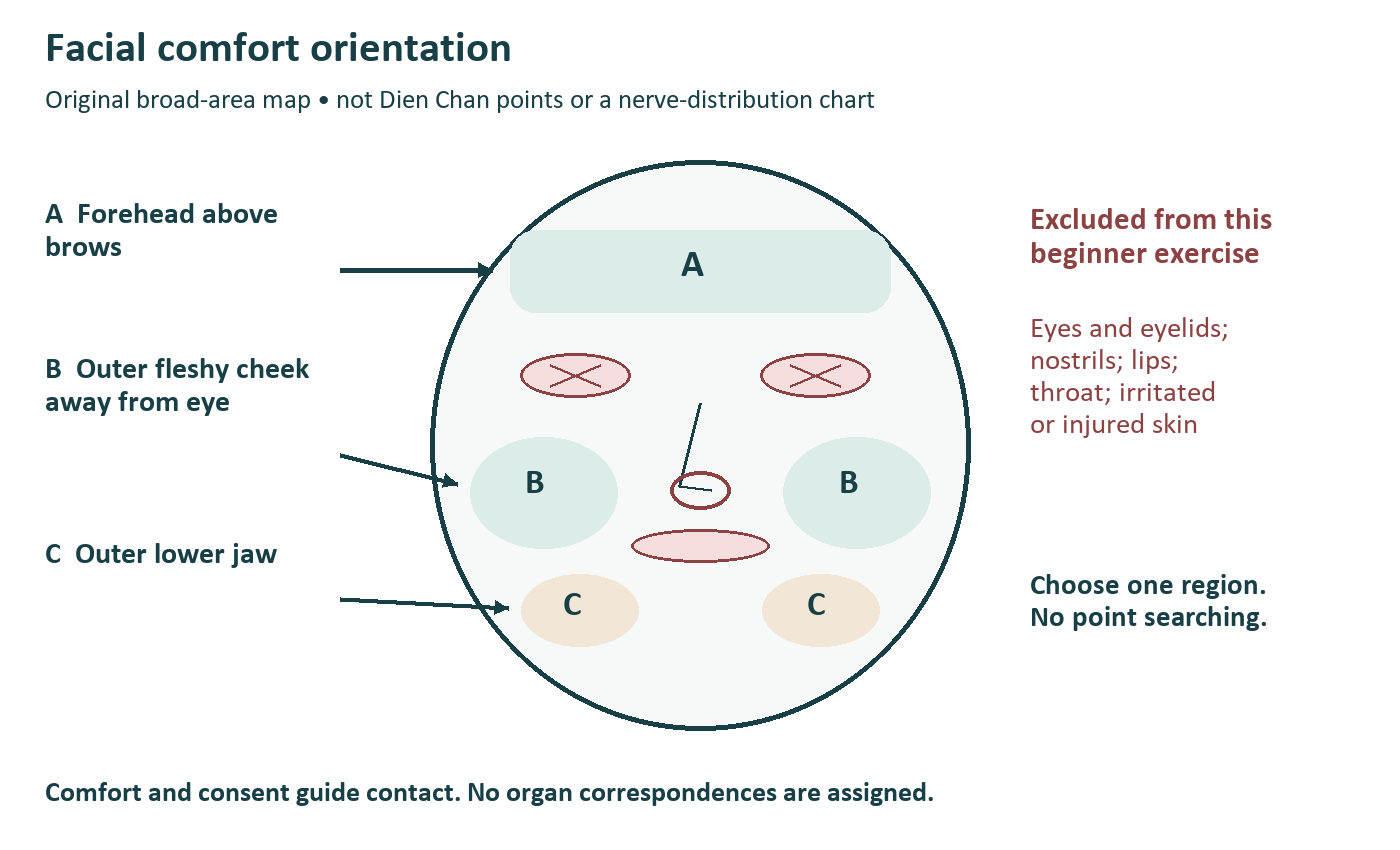
Visual 3 A simple facial orientation map

Three broad facial comfort regions with eyes, nostrils, mouth and neck excluded from beginner contact

Original comfort orientation map: A is the forehead above the brows; B is the outer fleshy cheek, below and away from the eye; C is the outer lower jaw. The shaded regions are broad orientation cues, not precise anatomical boundaries or Dien Chan bqc-points. The map has no organ correspondences.

Use: Select one region, ask permission, and use only comfortable contact on intact skin. There is no need to cover every region or both sides. Eyes and eyelids, nostrils, lips, throat, and irritated areas are excluded from this beginner exercise.

Observation-only alternative: Point to the areas on the picture and rehearse the permission question. A learner can complete this lesson without touching a face.

Caption exercise: Write a caption that prevents a reader from mistaking this picture for an official Dien Chan protocol.

Practice & reference

Meet the tools before using them

The International School of Multireflexology identifies tools by reference number and groups them into families including point tools, double-ended tools, facial/body tools, and larger-surface tools. Reference numbers help distinguish items whose translated names vary. [13]

Tool type Beginner learning task Boundary in this section
Smooth roller or smooth contact surface Identify the exact model, intended body area, and material Optional demonstration only after instructions are verified
Textured roller or brush Compare shape and intended use without testing on a client Texture is not permission for friction or stronger pressure
Detector or narrow point tool Recognize that this is precision equipment No point probing or tender-point searching in beginner practice

Ruth's supplied context: She reports using Dien Chan tools in an exploratory way and wants learners to avoid overwhelm. The exact tools, training history, pressure, duration, and cleaning instructions were not supplied. This package does not claim that her personal adaptations are the official method.

Tool demonstration checklist

  • Read the model number and locate the current manufacturer's instructions.
  • Verify the intended area, technique, maintenance, and suitable cleaning process.
  • Check the tool for rough edges or damage. Confirm clean hands and intact skin.
  • Explain the sensation and obtain separate consent before introducing a tool.
  • Follow the verified instructions; stop for pain, scratching, irritation, or uncertainty.

Do not invent one disinfectant, contact time, pressure, or stroke count for every tool material. If instructions or hygiene requirements cannot be verified, keep the tool out of shared practice. Use a facial model or clean-hand alternative instead.

Record before a future filmed tool lesson: Model number; source URL; date checked; cleaning instructions; demonstrated movement; intended area; stop criteria; instructor review. More precision belongs in a separately taught, verified lesson.

Lessons

Lesson 7 · Use a quick map and adapt

Outcome: Complete a brief comfort exercise with clear boundaries and factual notes.

Spoken teaching script

“A quick map should answer a few practical questions. What is the person's goal? Where might we offer comfortable contact? What will we do? How will we check? When will we stop?

“The cards that follow are original sensory-awareness exercises. They organize broad contact areas and conversation; they are not treatments for the organs traditionally mapped there. Their short timings are teaching limits, not scientifically established doses.

“First ask whether the person wants contact. Start with the least contact needed to explore comfort. Ask a neutral question. Make one adjustment at a time so the person can tell you what they prefer. You do not need to create a sigh, warmth, sleepiness, or an emotional response.

“A comfortable no-change experience is a valid outcome. So is choosing not to continue. Learning to respond well is more important than producing a dramatic result.”

Demonstration loop

Agree → contact → ask → adapt or stop → document.

Show the same brief exercise three ways: the person likes stillness; the person prefers less contact; the person wants to stop. In every version, thank them for the feedback and follow it.

Practice arrangement: In pairs, one person practices, one gives feedback. Swap only with consent. Solo learners use a model and speak both roles. Do not interpret your partner's medical history or encourage them to disclose personal experiences.

Common error: Repeating “Isn't that relaxing?” until the partner agrees. Replace it with “What do you notice, if anything?”

Practice & reference

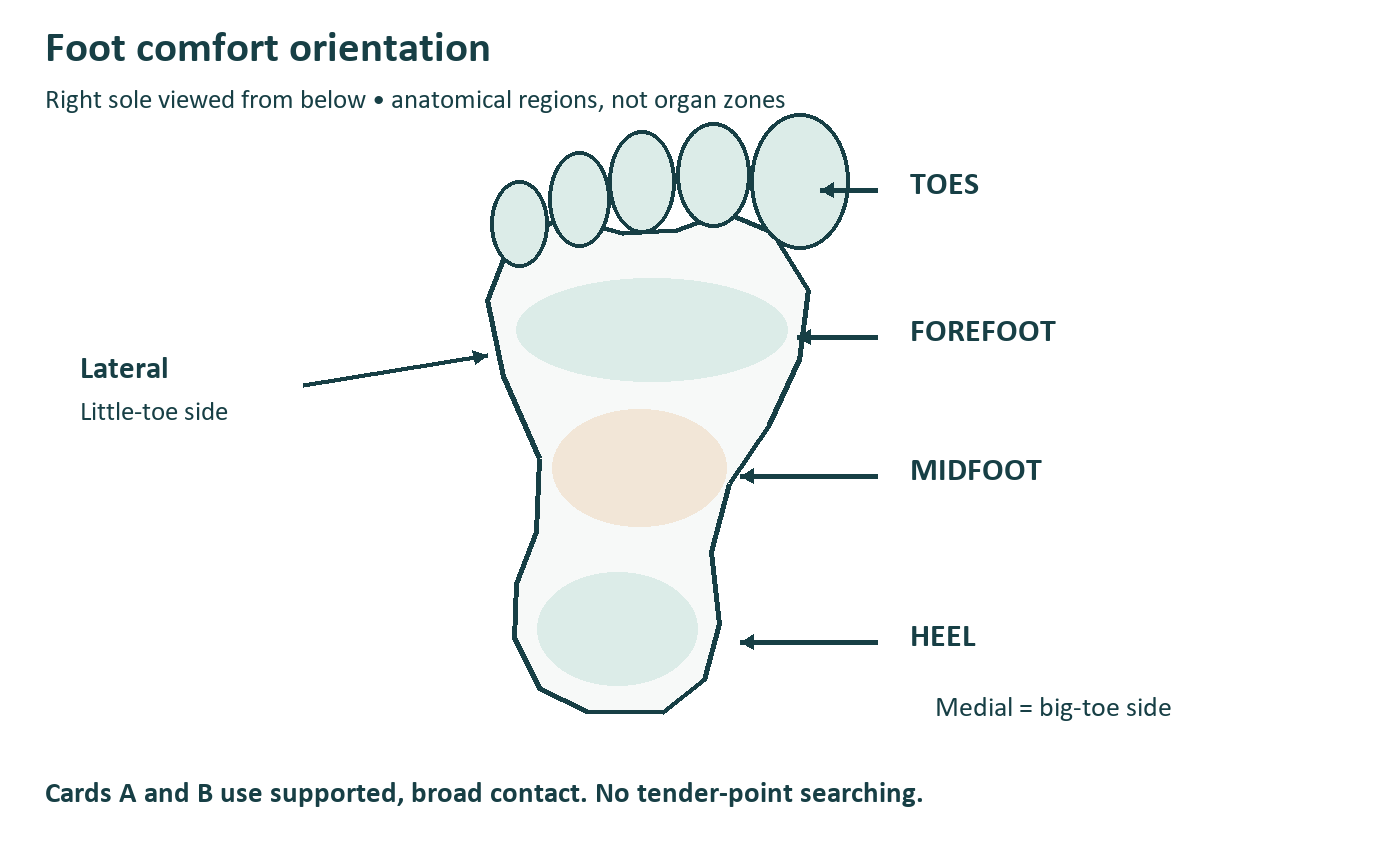
Visual 4 Broad foot regions for comfort practice

Right sole with toes, forefoot, midfoot and heel labeled as broad regions rather than organ reflexes

Orientation: A schematic right sole viewed from below, with the big toe on the viewer's right. The big-toe side is medial. Use the client's left/right, not the practitioner's. The four regions are anatomical orientation areas, not organ zones. The drawing is not to scale.

Use with Cards A and B: Begin at the supported heel if that is comfortable. Add broad contact at the plantar midfoot only if welcomed. Toes and forefoot are labeled for orientation; no pressure search, joint manipulation, or deep-point work is required.

Learning challenge: On a model, show the heel and midfoot, then describe how you would support the foot without pulling or twisting it. Rehearse a check-in before any partner practice.

Important distinction: A red mark, unusual texture, or tender area needs neutral description and appropriate action. Its position within a traditional chart does not establish an internal disorder.

Practice & reference

Card A Settling into the session

Goal: Explore comfortable, predictable contact. Map: Foot heel and plantar midfoot. Length: Up to two minutes. Status: Original comfort exercise; no organ target.

  1. Seat the person securely, with the leg supported and the foot within easy reach. Ask permission to hold the foot. If supporting it is awkward, use a model instead.
  2. Place one hand beneath the heel so the leg remains supported. Let the other hand rest broadly against the sole without squeezing, pulling, or pressing into a point.
  3. After a brief pause, ask: “How is this contact? Would you prefer less, different, or none?”
  4. Continue briefly only if comfortable. Let the person breathe normally; no breath holding or forced deep breathing is needed.
  5. Explain that you are ending contact, release gently while leaving the foot supported, and ask what they noticed.

Adapt: A towel barrier, self-contact, watching only, or no touch may be preferable. Do not assume light touch is always pleasant.

Stop: Pain, tingling that is new or worsens, numbness, guarding, skin irritation, distress, or withdrawal of consent. Do not increase pressure to push through a reaction.

What to say: “We are finding a comfortable starting point.”

What to record: Area, type of contact, client's words, and any adjustment. Example: “Supported right heel; broad still contact on sole. Client requested towel barrier, then said ‘comfortable.’”

Do not conclude: “Their nervous system reset” or “the organs balanced.”

Self-check: Could you describe this exercise without referring to an organ, a hormone, or an energy blockage?

Practice & reference

Card B A comfort break for tired feet

Goal: Offer a short rest for ordinary tiredness without investigating pain. Map: Supported heel, then broad midfoot if comfortable. Length: Up to three minutes. Status: Original comfort exercise; not treatment for foot disease.

  1. Ask what “tired” means to this person. New pain, an injury, altered sensation, or unexplained swelling is a reason to pause and seek appropriate assessment rather than assume ordinary fatigue.
  2. With consent, support the heel as on Card A. Begin with still contact.
  3. If welcome, move the resting contact once from heel toward the broad middle of the sole. Lift and replace the hand rather than drag or rub. Do not dig into the arch.
  4. Ask which position feels more comfortable. Stay with that preference briefly; do not search for a tender point.
  5. End contact and ask whether the foot feels the same, different, or less comfortable.

Adapt: Work through a clean towel or choose self-contact. If positioning is difficult, the learner can practice hand placement on a model and complete the same communication task.

Stop: Pain, new sensory changes, discomfort, or any request to stop. A painful, red, hot, or newly swollen foot or leg should not receive this exercise; unexplained symptoms need assessment.

What to say: “We can give your feet a comfortable rest. This does not tell us what is causing a symptom.”

What to record: Location and reported comfort, including no change. Do not describe pressure changes as breaking up crystals or clearing toxins.

Teaching prompt: Ask the learner to name one reason to choose rest without touch today.

Practice & reference

Card C Gentle facial comfort

Goal: Explore whether brief facial contact is welcome. Map: One broad region from Visual 3. Length: Up to two minutes, beginning with only a few seconds. Status: Original clean-hand exercise; not a Dien Chan point protocol.

  1. Begin on your own face or a model. For a partner, obtain separate facial-contact consent and confirm comfortable positioning. Hands should be clean; skin should be intact and free of irritation.
  2. Choose the forehead above the brows or the fleshy outer cheek well away from the eye. The outer lower jaw is an alternative only if comfortable and symptom-free.
  3. Rest the soft pads of your fingers lightly on that single area for a few seconds. Do not rub, scrape, tap, probe, or press into the jaw joint. Keep nails clear of skin.
  4. Remove contact and ask what the person noticed. Repeat briefly only if requested and comfortable. There is no requirement to complete a sequence or make the skin red.
  5. End with a neutral comparison: “Same, more comfortable, or less comfortable?”

Exclude: Eyes and eyelids, nostrils, lips, throat, broken or inflamed skin, active skin infection, and areas affected by a recent facial or dental procedure until the treating clinician's aftercare permits contact. Avoid known material sensitivities. Unexpected electric-shock facial pain warrants stopping and clinical assessment. [8]

Tools: Do not substitute a detector or textured roller into these instructions. Tool technique requires its own verified instruction. Card C remains usable without equipment.

What to say: “This is gentle surface contact for comfort. You can choose no facial touch.”

Do not conclude: “This cheek point treated the lungs,” “we drained lymph,” or “we released stored trauma.” None was measured by this exercise.

Practice & reference

Card D Winding down without a sleep promise

Goal: Create a brief opportunity to pause. Map: Choose Card A, Card C, or no touch. Length: Up to three minutes. Status: Original comfort exercise; not an insomnia treatment.

  1. Ask: “Would you prefer quiet, conversation, or no touch?” Let the person keep their eyes open and choose a comfortable position.
  2. Agree on one area if contact is wanted. Use the corresponding card's boundaries. Avoid adding several new inputs at once.
  3. Offer ordinary, unforced breathing. Do not impose a breathing count or ask the person to hold their breath.
  4. Check once after beginning, and respond promptly to any discomfort. Quiet does not remove the need for consent.
  5. End clearly, give the person time to orient, and ask for their description of the experience.

Adapt: Silence may be uncomfortable. Offer conversation, looking around the room, or stopping. If someone appears distressed or unusually unresponsive, stop and assess the situation; do not label it deep relaxation.

What to record: “Client chose no touch and quiet sitting; reported feeling less rushed.” This is a worthwhile report even though it does not prove a physiological mechanism.

Do not conclude: “Theta state achieved,” “cortisol reduced,” or “sleep disorder corrected.” Persistent sleep difficulties belong with appropriate health care.

Choosing among the cards

Choose by the person's preference and the learner's demonstrated skill, not by matching a symptom to an organ. A tired person may prefer conversation. Someone asking for facial work may decide against it after a brief trial. Respect the updated choice.

Practice & reference

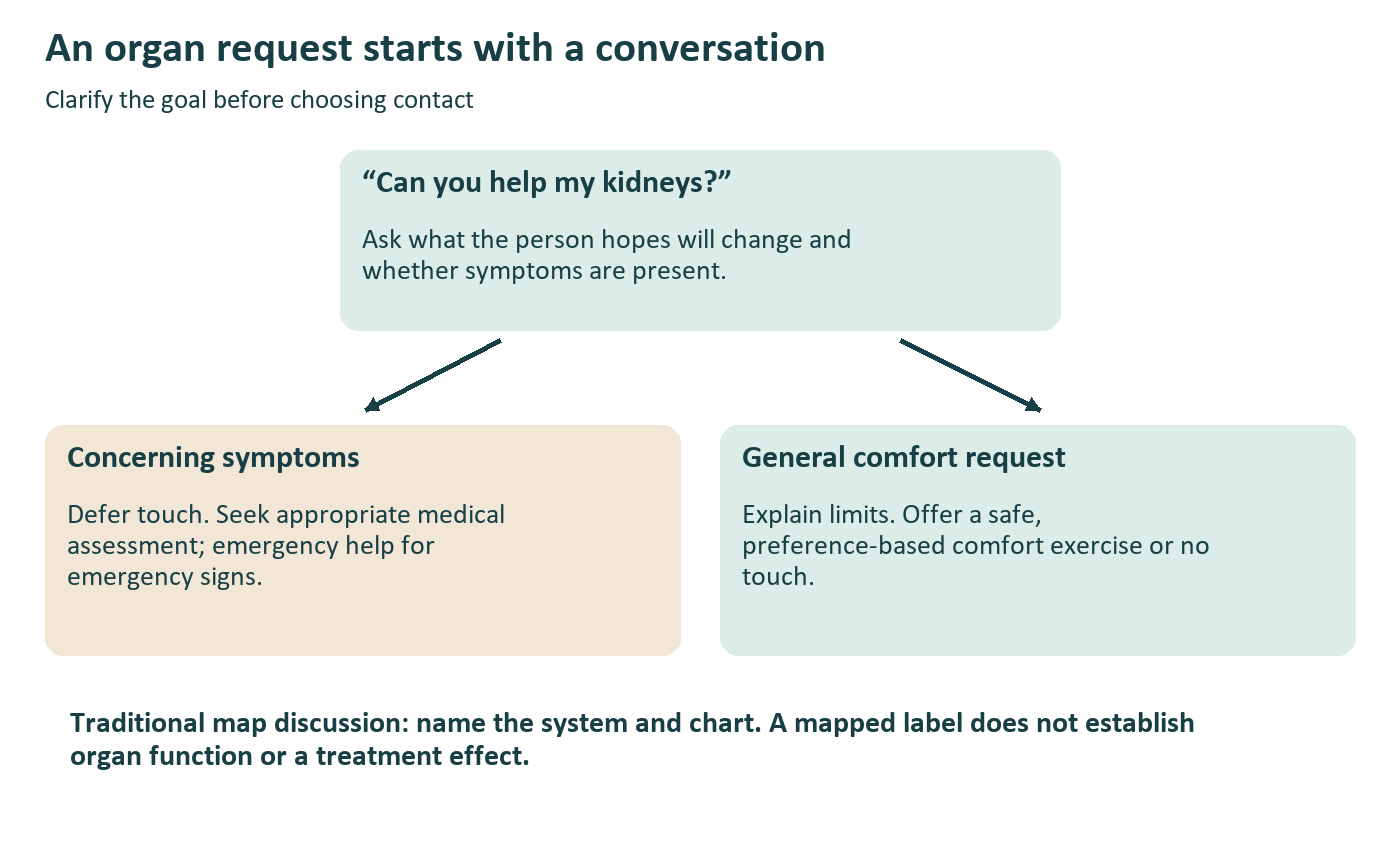
Card E When someone asks for organ support

Goal: Clarify the request and choose an appropriate next step. Map: A conversation map, not a treatment route. Examples: Kidney flush, digestive support, headache relief, sinus clearing, or hormone balancing.

Conversation pathway from an organ request to symptom clarification, medical assessment when indicated, or a preference-based comfort session

Ask: “What are you hoping will change?” Then ask whether there are new, persistent, severe, or unexplained symptoms. Do not conduct a diagnosis through point tenderness.

If symptoms are concerning: Defer the routine and recommend appropriate clinical assessment. For the kidney example, use the specific warning signs in Lesson 5. Sudden severe symptoms or signs of a medical emergency require emergency care.

If the request is general comfort: Explain the limits and offer a card based on preference and safety. “I can offer a comfortable session, but I can't promise to change that organ's function.”

If the client wants a traditional explanation: Identify the chart, author or school, and edition. Say “This system maps this area to…” rather than “This area controls…”. Different maps should not be silently combined.

Deeper study: A precise organ-labeled visual needs a selected, appropriately licensed chart and method-specific teaching. No exact organ points are invented in this package. The cards above are complete beginner comfort exercises that can be taught independently of that optional advanced material.

Lessons

Lesson 8 · Explain your approach to a client

Outcome: Give a clear explanation and respond responsibly to surprising reactions.

Spoken teaching script

“You do not need to give a neuroscience lecture to explain your session. Tell the person what you will do, what they can choose, and what you can reasonably say about it.

“Try this: ‘I use comfortable touch and, when relevant, traditional reflexology maps to organize the session. We'll check what feels right for you. Some people find sessions relaxing; experiences vary. I can't diagnose a condition through your feet or promise changes in a mapped organ. You can ask me to change or stop at any time.’

“If you are offering only the exercises in this section, name them as introductory comfort exercises. Do not present them as professional Dien Chan treatment or a complete foot-zoning method.”

Responding in the moment

Client or event Responsible response
“That point hurts. Is it my liver?” “Tenderness here doesn't tell me how your liver is working. I'll stop that contact. Is the discomfort new or something you are already having assessed?”
Client's stomach makes a sound “I heard a sound. How are you feeling?” Do not assign a digestive cause to the mapped contact.
Client cries “Would you like me to stop, give you space, or end the session?” Do not request a trauma story or interpret the tears.
“I feel calmer” “Thank you for telling me. Would you like to continue this way?” Record the report.
“Nothing changed” “That's useful to know. Would you prefer a change, or shall we finish?”

Final rehearsal: Explain your approach in 30 seconds, then respond to one of the examples. Your partner listens for one clear limit and one genuine choice.

Practice & reference

Workbook 1 Notice without adding a cause

Use a fictional scenario, self-practice, or a consenting adult. Do not include identifying health information in shared coursework.

Area and contact used: __________________________________________

What I directly observed: _______________________________________


The person's exact words: _______________________________________


My interpretation or question, if any: ______________________________


What remains unknown: _________________________________________


What I changed or stopped, and why: _______________________________


A factual one-sentence note: _____________________________________


Worked example

Observation: The person moved their foot away. Report: “That's ticklish.” Interpretation: They may prefer a different contact, but I need to ask. Unknown: The cause of their sensitivity. Action: Removed contact; they chose a towel barrier. Note: “Client withdrew right foot and reported ticklishness; contact stopped, then resumed through towel with consent.”

Reflection: Did I invite the person's answer, or suggest the answer I hoped to hear?

Practice & reference

Workbook 2 Build a responsible quick card

Use one broad comfort goal. Do not create a disease-treatment prescription.

Card name and goal: ____________________________________________

Status: Original comfort exercise / identified traditional reference / research summary

Chosen area and clear orientation: _________________________________

Sketch: Draw the body surface and label left/right where relevant. Mark excluded areas. Do not draw a nerve or organ connection unless the source actually establishes it.


What the learner will do: ________________________________________


Consent question: _____________________________________________

Stop or defer criteria: __________________________________________

What the learner may reasonably say afterward: _____________________


Source and edition for any traditional map or tool instruction: ___________

What this card does not establish: _________________________________

Peer review: Can another learner find the area? Are the instructions comfortable and within their training? Is the map type explicit? Is there a genuine stop option? Does any sentence make an organ or disease claim unsupported by the exercise?

Practice & reference

Workbook 3 Investigate one claim

Claim I want to understand: ______________________________________

Source title and URL: ___________________________________________

Who produced it: Research group / health agency / school / manufacturer / other

What kind of evidence is it: ______________________________________

Who or what was studied: ________________________________________

Technique and comparison: ______________________________________

Measured outcome and follow-up: _________________________________

Result, including uncertainty or no benefit: __________________________


Does it match the population, technique, and goal on my card? __________

What stronger claim would be unjustified? ___________________________

My revised explanation in plain language: ___________________________


Optional exploration plan

Choose one path: sensory anatomy; research literacy; supervised foot reflexology; or Dien Chan tool and point training. Pick one reliable resource and one question. Study in small steps. Do not combine points from unrelated systems into a new treatment prescription.

My next question: ______________________________________________

How I will get feedback before offering a new technique: ________________


Practice & reference

Learning check

Answer before reading the key. Each item is worth one point.

  1. Name the central nervous system's two main structures.

  2. A client says “my foot feels warmer.” Which category does this belong to? What does it not establish?

  3. Rewrite: “You yawned, so your vagus nerve has switched you into healing mode.”

  4. A tender area is labeled “kidney” on a chart. What can you conclude about kidney function?

  5. How does a numbered Dien Chan point chart differ from an anatomical nerve diagram?

  6. A trial of a foot protocol reports improved symptom ratings in one population. Does this prove a facial tool will have the same effect? Explain briefly.

  7. Someone becomes silent with eyes closed. Name one appropriate check-in and one claim to avoid.

  8. A person asks for a kidney flush and reports fever, painful urination, and side pain. What is the next step?

  9. Your roller's model and cleaning instructions are unknown. What should you do in a shared beginner practice?

  10. Rewrite: “Your stomach gurgled when I worked its reflex, so we know the digestive system is unblocked.”

  11. The client says a contact is too much but you are halfway through the map. What takes priority?

  12. Give a 30-second explanation of your approach that includes purpose, uncertainty, and choice.

Proposed learning standard: At least 10 of 12, with items 4, 8, 9, and 11 correct before partner practice continues. This is an internal teaching suggestion, not a certification standard. Review missed items and repeat with a different scenario.

Practice & reference

Answer key and practice assessment

  1. Brain and spinal cord.

  2. Client report. It does not establish blood-flow changes, organ function, or why the warmth occurred.

  3. “I noticed you yawned. How are you feeling?” No physiological state is inferred.

  4. Nothing about kidney function from that tenderness alone. Stop uncomfortable contact and respond to symptoms appropriately.

  5. The point chart describes a traditional mapping system. An anatomical diagram describes identified structures. Point numbers are not a census of nerve endings.

  6. No. Different technique, body area, population, and outcome require their own evidence.

  7. “Is this still comfortable?” Avoid claiming theta waves, a specific autonomic state, or trauma release.

  8. Defer reflexology and recommend prompt medical care for possible kidney-infection symptoms; emergency help for severe illness or emergency signs. Do not attempt a flush.

  9. Keep it out of shared practice until identification, instructions, and hygiene requirements are verified. Use a model or clean-hand alternative.

  10. “I heard a stomach sound during the session. How are you feeling? That sound doesn't establish an effect on digestion.”

  11. The person's comfort and consent. Stop or adjust immediately; completing a map is not the goal.

  12. Accept wording that accurately describes comfortable touch, traditional maps if used, limits on diagnosis and promised outcomes, and the option to stop.

Five-minute practical assessment

Score each as demonstrated or needs practice: obtains specific consent; identifies the correct surface; starts with comfortable contact; asks neutrally; responds immediately to discomfort; distinguishes observation from report; makes no organ or brainwave inference; ends and documents clearly.

Pass for this exercise: All eight demonstrated. Any failure to honor consent or stop for discomfort requires coaching before another partner exercise. This check assesses the introductory exercise only, not professional competence in reflexology or Dien Chan.

Production & sources

Instructor filming and facilitation guide

Keep the pace varied: Teach one idea, show it, pause for retrieval, then apply it. Use short captions rather than dense point labels. Leave enough screen time to read every map.

Segment Visual and action Learner task
Sensory foundations Trace Visual 1 without an organ overlay Explain the route in one sentence
State and comfort Act the talkative and quiet-client examples Choose a neutral question
Four categories Reveal Visual 2 one category at a time Sort statements before the answer
Research lab Show study title, groups, and measured outcomes Name one limit on the conclusion
Foot zoning Read the kidney-flush conversation Replace a causal claim
Facial introduction Use Visual 3 and a mirror Identify broad areas without point probing
Tool literacy Show model number and instructions Distinguish identification from competency
Map practice Show full hand support and client feedback Practice stop and adjustment responses

Camera notes: Use an overhead or side view that shows both hands and the supported limb. Keep client left/right labels visible and do not mirror footage. For facial work, first use a model or self-demonstration. Show the eye exclusion clearly. Never zoom so tightly that learners lose orientation.

Accessibility: Provide captions, transcripts, labeled visuals that do not rely on color, and a no-contact route. Read key visual labels aloud. Do not require closed eyes, quiet breathing, emotional disclosure, or partner touch as evidence of participation.

Before student release: Review the original comfort exercises with the instructor; confirm applicable scope and C02 safety alignment; verify any actual tool demonstration against its model-specific instructions. These are production tasks, not work completed by this written draft. No video has been filmed and no school affiliation is implied.

Production & sources

Research and source notes

Sources checked September 24 2026. Links identify the source of factual statements; exercises, cards, scripts, and assessments are original teaching proposals. School and manufacturer descriptions establish what those organizations teach or sell, not independent clinical effectiveness.

1. Sensory foundations

OpenStax Anatomy and Physiology 2e Sensory Perception

Supports receptor categories, sensory processing, and body-sense terminology. Visual 1 is an original simplified educational diagram.

2. Autonomic foundations

OpenStax Divisions of the Autonomic Nervous System

Supports introductory distinctions between autonomic divisions; does not validate reading an individual's state from a reflexology session.

3. Brain electrical activity

MedlinePlus EEG

Explains EEG measurement. The course's caution against inferring measured brainwaves from appearance follows from the distinction between behavior and measurement.

4. Pain and experience

NINDS Pain

Supports individual pain experience and nervous-system context. Not a reflexology mechanism study.

5. Reflexology overview and research literacy

NCCIH Reflexology

Distinguishes proposed correspondences from demonstrated effects and links to research-literacy resources. Page last updated January 2020; used alongside the more recent guidance summary below.

6. Evidence in a specific clinical context

NCCIH Psychological or Physical Approaches for Cancer Symptoms

Summarizes 2022 and 2023 integrative oncology recommendations. These conditional, setting-specific recommendations must not become broad disease claims or beginner oncology protocols.

Production & sources

Research and source notes continued

7. Primary research example

Wyatt and colleagues 2012 reflexology trial

Use the study's actual groups and outcomes. This package uses the abstract for the classroom exercise; it is not a full risk-of-bias appraisal.

8. Facial sensory anatomy and pain

NIDCR Trigeminal Neuralgia

Explains the trigeminal nerve and facial pain. It does not validate facial organ maps. Visual 3 is a broad surface orientation picture, not a nerve-distribution diagram.

9. Kidney physiology

NIDDK Your Kidneys and How They Work

10. Kidney symptoms requiring care

NIDDK Symptoms and Causes of Kidney Infection

NIDDK Kidney Infection overview

Support the referral example and individualized fluid guidance. This course does not teach diagnosis or treatment of urinary conditions.

11. Touch safety context

NCCIH Massage Therapy What You Need To Know

Supports caution around injury risk and avoiding delayed medical care. The beginner exclusions here are conservative course rules, not an exhaustive contraindication list or universal manufacturer protocol. Use C02 for the fuller safety foundation.

Practice & reference

Quanta and Dien Chan research notes

12. Quanta School of Reflexology

Quanta Dien Chan Online Pro

Quanta frequently asked questions

The public program describes a progression from foundations to advanced point work and lists diagrams, express care cards, tools, recorded content, and guided learning. Those features support a manageable learning format. This course does not copy their charts, course text, care cards, or proprietary sequences.

Quanta facial routine video description

The public description identifies a short facial routine and tools numbered 376, 206, and 252. Only the publicly indexed description was reviewed, not a frame-by-frame technique demonstration. These numbers are not assumed to be Ruth's tools.

Specific limitation: The user's referenced “kidney flush” lesson was not located in the accessible public material during this review. No sequence is attributed to it, and the user's recollection is not treated as a verified medical claim.

13. International School of Multireflexology and tool references

Dien Chan Multireflex international school

Multireflex tool classification

These sources describe the method's tradition and tool families. Organ correspondences and yin-yang explanations should be labeled as features of the method, not established neuroanatomy. This targeted search did not establish clinical effectiveness for the specific facial comfort exercises or an organ-flushing effect.

Recommended next learning step: Select one tool or one map with its exact reference, study the official instruction, and obtain qualified feedback. Do not learn all points at once. Do not describe a personal adaptation as an official protocol.

Course development boundary: Exact organ-targeted maps and tool-specific sequences remain optional advanced content requiring an identified source and verified technique. The eight lessons, broad comfort cards, workbook, and assessment in this package are complete as a written introductory section.

A note for this section

Review workspace

Where your comments live

Connect to the website to share notes with each other. On a static host, use this browser and export your comments to share them.

The access code is in the separate upload guide. Everyone with it can read, edit and resolve review notes.


Device comments are kept in this browser, not sent to anyone. Export a backup before clearing browser data or switching devices.