REFLEXOLOGY REVISITED · COURSE REVIEW EDITION
← All chapters

Chapter 10 / 12 · 7 lessons

Close, document & follow up

Give the ending care, invite feedback and keep useful records.

Review marks stay on this device.

Lessons

Chapter overview

Reflexology with Ruth • Section 10

Let the session end gently. Let the client's account remain their own.

The last few minutes are still part of the care you offer. How you release contact, make room for feedback, remember preferences, and respond later all matter. A quiet ending can be attentive without requiring a special feeling, a spiritual explanation, or a positive review.

This teaching draft develops Ruth's supplied account into seven lessons, five visual guides, rehearsal scripts, a blank record, a fictional completed example, scenarios, and a practical assessment. Added language and procedures are curriculum proposals, not claims about Ruth's current practice. Videos remain to be recorded.

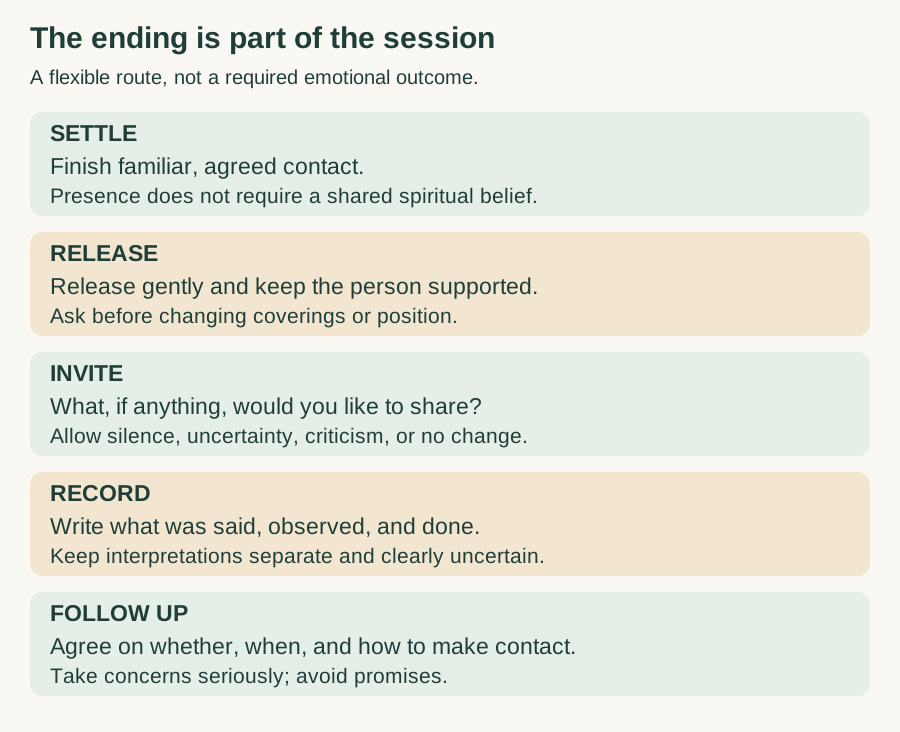
Closing route: settle, release, invite, record, follow up

Lessons

Your learning route

By the end, you can:

  • Close familiar, consented contact without rushing or adding surprise touch.
  • Invite feedback without predicting the client's experience.
  • Separate client reports, observable events, practitioner sensations, and interpretations.
  • Produce a minimal, anonymized learning record and explain its privacy limits.
  • Offer modest aftercare and respond appropriately to discomfort or dissatisfaction.
  • Agree on follow-up without pressure to reply, book again, or disclose personal material.

Prerequisites: Sections 2 and 5–9, including consent, safe setup, taught contact, observation, and adaptation. This section does not qualify learners to perform head or neck techniques, operate devices, diagnose symptoms, or provide counseling. Rehearse in dialogue only until practical prerequisites are met.

Activity Suggested time
Seven lessons 35 minutes
Demonstration and replay 10 minutes
Notes and feedback workshop 20 minutes
Scenario practice 15 minutes
Knowledge check and debrief 10 minutes
Total 90 minutes

Opening prompt: A client opens their eyes and says, “I didn't feel anything.” What would you say? Write your first response now; revisit it after Lesson 10.3.

My first response: ___

Lessons

Lesson 10.1 · Presence without a required outcome

Outcome: explain the intention behind Ruth's ending without presenting a belief as a measured mechanism. Suggested time: 5 minutes.

Proposed narration

“I want my ending to feel as attentive as the rest of the session. I can slow down, release contact deliberately, and give the person time. I do not need them to feel what I feel or explain their experience in my language.”

Ruth describes a quiet hold at the ankles or heels, imagining energy returning to the earth. She emphasizes awareness, compassion, and presence over a prescribed intention or exact movement. She compares the intention to comfort someone with the caring intention of holding a distressed child. In teaching adults, retain their autonomy: comfort is offered, never assumed, and the analogy does not justify treating a client as a child.

Spiritual lens: “For me, imagining grounding helps me stay present.” Unsupported conclusion: “This hold released the client's energy into the earth.” A personal experience can be meaningful without establishing what happened in someone else's body. NCCIH reports no scientific evidence for the energy field proposed in Reiki; that source is relevant to energy-field claims, not proof about every detail of Ruth's method. [1]

Students need not share a spiritual belief to practice attentive contact. A secular intention such as “I will remain kind, observant, and responsive” fits this lesson. If a client does not want spiritual conversation, honor that preference.

Pause and compare: “I noticed warmth in my hands” describes your sensation. “Their grief left through their feet” assigns an unverified cause and meaning. Neither becomes a client report unless the client actually says it.

Lessons

Lesson 10.2 · The last few minutes

Outcome: demonstrate a predictable close with consent, comfort, and safe departure. Suggested time: 6 minutes.

Agree on the ending before the quiet begins

“Toward the end I will finish the agreed foot contact and release my hands slowly. You can keep your eyes open or closed. I'll let you know when we are finished; take your time before sitting up. Please tell me if you want anything changed.”

Silence is a preference, not a rule. Speak whenever a change needs agreement or a safety check. Closed eyes, stillness, or apparent sleep do not establish consent for additional areas.

Approximate final five minutes Do Possible words
First minute Finish familiar, agreed contact; optionally use a taught, comfortable heel hold Quiet if previously agreed
Second minute Release gradually; support the feet securely “The contact is finished.”
Third minute Explain removal of supports or coverings; check readiness before changing position “Would you like the covering left on for now?”
Fourth minute Invite feedback after the person is alert and comfortable “What, if anything, would you like to share?”
Fifth minute Offer concise aftercare and agree on any contact later “Would a brief check-in tomorrow be welcome?”

This is a rehearsal budget, not a countdown. Access needs and symptoms override the schedule. If five minutes will not be sufficient, reserve more closing time earlier.

Translate Ruth's routine into beginner choices

Ruth reports heel or ankle holds, light strokes over the feet, toe contact, lifting a foot to remove a cloth, shoulder contact, head support, removing a scarf, and scalp compression. These are options from her account, not a required chain. Beginners use only contact already taught, appropriate, and agreed. Shoulder, scalp, head, and neck work require separate competence and consent; omit them from the default feet-only close. Do not pull a scarf from beneath the neck or lift a head or limb using an untaught maneuver.

Ruth also describes removing LEDs, stones, coverings, and a chair armrest. These additions are not required. Any equipment used earlier must be stopped and removed according to its instructions and the agreed setup; do not extend device exposure to preserve silence. Keep supports in place until no longer needed. Explain covering removal, preserve warmth and modesty, and move the armrest only when the client is clear of it and the chair's instructions allow. Never use a moving armrest as a transfer support.

“Sam, the session is finished. How are you doing?” Allow a response. Offer water only when the person is alert, comfortably positioned, and able to drink safely. Ask what help they want before assisting movement. Do not rush standing, pull them upright, or encourage driving while dizzy. Unexpected difficulty waking or abnormal responsiveness requires urgent assessment, not a longer “integration” period. [5,6]

Lessons

Lesson 10.3 · Invite feedback without planting an answer

Outcome: use neutral questions and accept silence, uncertainty, or dissatisfaction. Suggested time: 5 minutes.

Ruth asks, “Do you have anything you would like to share, or do you have any questions for me?” This is an effective starting point. Ask one question, then leave room. An invitation is not a request for a performance.

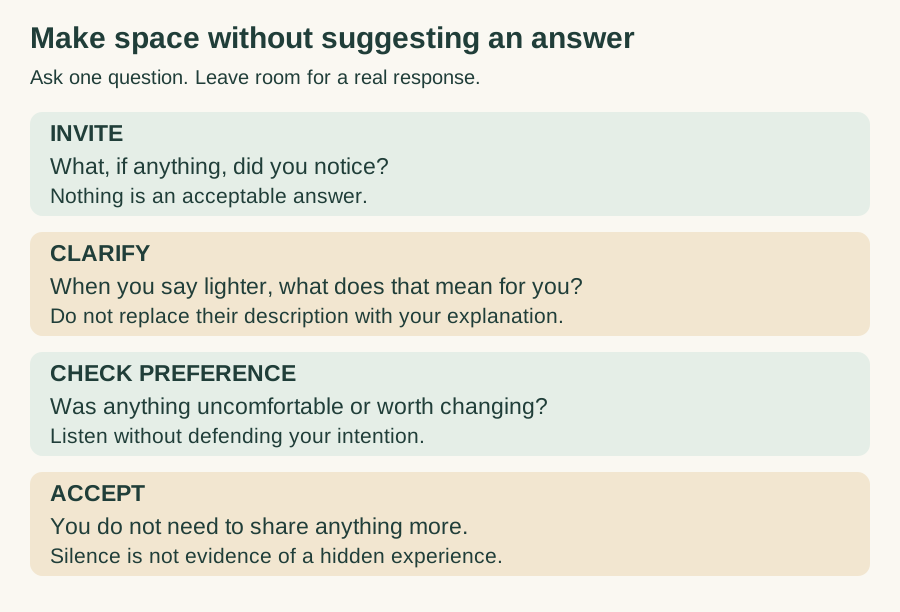
Feedback funnel: invite, clarify, check preference, accept

Avoid Try instead Why
“You felt the energy release, didn't you?” “What, if anything, did you notice?” Does not suggest a sensation or mechanism
“You went very deep.” “Would you like a quiet moment or to talk?” Does not diagnose a state from appearance
“You look relaxed.” “How are you feeling right now?” Gives the client ownership of the description
“Wasn't that wonderful?” “Was anything uncomfortable or something you would change?” Makes criticism welcome
“That dream means you're healing.” “Would you like to say more about what it meant to you?” Does not interpret the client's life

If they say “nothing”: “Thank you for telling me. There isn't a particular experience you need to have. Was the session comfortable, or is there anything you would change?” Do not persuade them that an invisible benefit occurred.

If they remain quiet: “You don't need to put anything into words. You can share later if you want.” Do not infer that their silence conceals something profound.

If they use an ambiguous word: “When you say ‘lighter,’ what does that mean for you?” If they decline to explain, accept that. Do not turn routine feedback into an emotional investigation.

If they ask for a spiritual interpretation: “I can share my personal perspective if you want, but I can't know what your experience means.” Avoid claiming access to trauma, diagnoses, or hidden memories. Offer a reading suggestion only with permission, label its spiritual perspective, disclose relevant commercial ties, and do not present it as required treatment. No specific author was supplied by Ruth, so none is represented here as her recommendation.

Lessons

Lesson 10.4 · Write a factual service record

Outcome: produce useful notes without making clinical claims. Suggested time: 5 minutes.

Ruth says she rarely keeps readable written records and may remember preferences such as avoiding an eye covering. This course adds a minimal written-record exercise. It does not portray the form as her existing practice.

Not holding a clinical license does not, by itself, establish that all notes are inappropriate or prohibited. Recording consent, service details, client requests, and actions is different from diagnosing or creating a clinical treatment plan. The jurisdiction, credential, employer, and insurer may set specific requirements; none has been established for this lesson. Before professional use, verify the rules that apply to the actual service and location. Do not assume calling a service “energy work” creates an exemption.

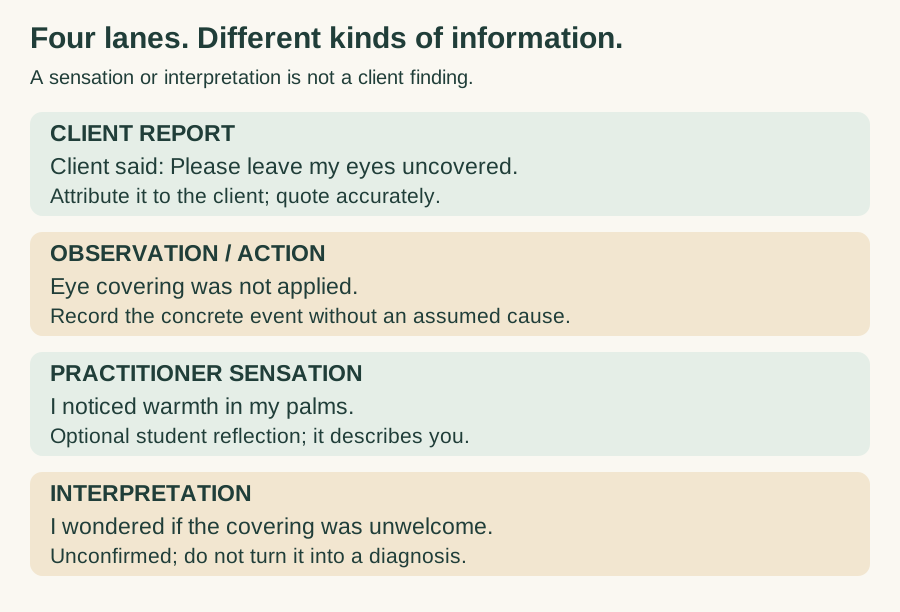
Four evidence lanes for accurate notes

Lane Suitable example Common error
Client report Client said, “Please leave my eyes uncovered.” Writing “has trauma” from a preference
Observable event or practitioner action Eye covering was not applied; client sat upright before departure Writing “nervous system reset”
Practitioner sensation I noticed warmth in my palms; optional learning reflection only Attributing that warmth to the client's condition
Interpretation I wondered whether the covering was unwelcome; unconfirmed Writing speculation as established fact

In a routine client record, omit speculative interpretations unless there is a clear, legitimate reason to include a labeled reflection. In the student exercise, keep that reflection in its own box so the distinction can be assessed. It is not a diagnosis and must not become the basis for claims about the client.

Record promptly, with the session date and author. Quote accurately; label a paraphrase rather than putting invented wording in quotation marks. Record what was done, what changed, what the client said, and what was agreed next. “No concerns reported when asked” is narrower than “no adverse effects.” Do not assume that the absence of a complaint proves safety or effectiveness.

If correcting a record, preserve the original entry and add a dated correction or use the system's audit trail. Label late entries. Record later reports as later reports; do not rewrite the original session to make it seem that you knew then what you learned afterward.

Lessons

Lesson 10.5 · Protect information and anonymize learning

Outcome: explain who needs the record, where it belongs, and what cannot go into a class submission. Suggested time: 4 minutes.

Use a secure professional record process for actual clients. This browser workbook is for fictional or properly anonymized learning material only. Entries are not deliberately saved by the lesson and disappear when the page reloads; browser history, shared devices, printouts, or screenshots can still expose information. It is not a secure client-record system.

Keep only necessary information, restrict access, secure paper records and devices, and have a documented retention and secure-disposal process. Follow applicable retention requirements before deleting anything. Explain your record and communication practices to clients. Do not put identifiable session details into a shared course folder, a personal AI chat, or a public teaching example. These course practices build on the FTC's business information-security guidance. [3]

HIPAA does not automatically cover every wellness practitioner. Applicability depends on covered-entity or business-associate status; other obligations can still apply. This lesson does not certify HIPAA compliance or set a universal retention period. [2]

Class submission checklist

  • Use a fictional example whenever possible; clearly label it fictional.
  • Remove names, initials, contact details, exact dates, birth dates, and identifying locations.
  • Remove distinctive jobs, family events, and unusual stories that could reveal the person.
  • Do not attach screenshots, photographs, or copied message threads from actual clients.
  • Keep any identity key out of the teaching file; a code with a retained key is pseudonymized, not fully anonymous.
  • Inspect filenames and document metadata, not only the visible page.
  • Follow the institution's permission and privacy process before using any real case.

Try now: “Client AB, the town's only harp teacher, came the day after her daughter's wedding.” Removing “AB” is not enough. For a teaching example, omit the distinctive biography and use a fictional case instead.

Lessons

Lesson 10.6 · Aftercare that leaves room for the person

Outcome: offer practical information without prescribing a reaction or explaining symptoms away. Suggested time: 5 minutes.

Proposed departure script

“Take your time getting up. Water is available if you'd like it. Continue your usual hydration and follow any fluid advice from your healthcare professional. You don't need to have a particular feeling after this session. If something is uncomfortable or concerning, please take it seriously and seek appropriate healthcare advice. You're welcome to tell me about it too.”

Ruth encourages hydration. Retain the offer without teaching that reflexology releases toxins or requires extra liters of water. General hydration advice supports ordinary fluid intake; it does not establish a reflexology-specific detox process. Existing fluid restrictions take priority. [4,7]

Ruth also describes dreams, processing, and the possibility of finding meaning in difficult experiences. A client may choose that interpretation. The practitioner should not label pain, insomnia, emotional distress, or worsening symptoms as necessary processing, a healing crisis, or proof that a session worked. Meaning-making must never delay care or pressure someone to tolerate discomfort.

Respond according to the concern

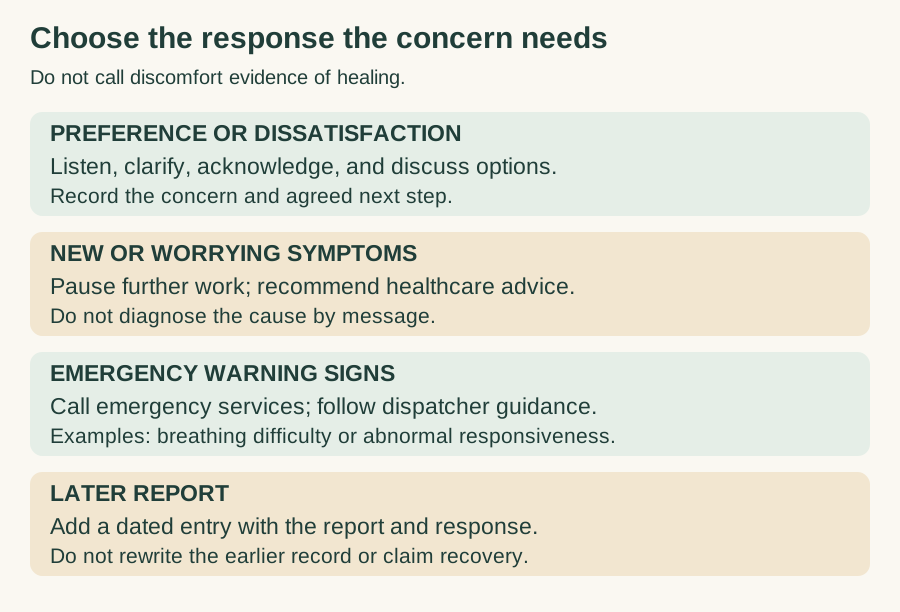
Response guide for preferences, symptoms, and emergencies

For a preference or disappointing experience: listen, clarify what was wanted, acknowledge the mismatch, and agree on an appropriate remedy. For new, persistent, worsening, or worrying symptoms: stop further work and recommend healthcare advice; do not diagnose their cause. For emergency warning signs, use emergency services promptly. Chest pain, difficulty breathing, fainting, new confusion, or difficulty arousing are examples, not an exhaustive list. In the US call 911; use the local emergency number elsewhere. Never wait for a practitioner message reply in an emergency. [5]

If dizziness occurs at departure, keep the person safely supported, avoid sudden standing, and seek appropriate help. Do not frame unsteadiness as spiritual depth. The NHS advises avoiding driving and other dangerous activities while dizzy. [6]

Teach-back: “Just so I know I explained it clearly, what would you do if you had a new symptom that worried you?” This checks your explanation; it is not a test of the client.

Lessons

Lesson 10.7 · Professional follow-up and repair

Outcome: agree on limited follow-up and respond without defensiveness. Suggested time: 5 minutes.

Before sending anything, ask: “Would you like one brief check-in tomorrow? Which channel is private enough for you, and is there a good time?” Record the answer and honor a no. A next-day message is a course example, not a clinical standard. Explain realistic reply hours and that messaging is not monitored for emergencies. Keep marketing permission separate.

Proposed message library

Opted-in check-in: “Hi [preferred name], this is [practitioner], checking in as agreed. Is there anything you would like me to know after your visit, or anything you would prefer changed? No reply is needed. I read messages during [actual reply hours]. For urgent health concerns, please seek medical help rather than waiting for a reply.”

No reply: Do not send repeated messages to obtain praise or a booking. One agreed message is enough unless the person requested more or another specific duty applies.

Discomfort: “I'm sorry you're uncomfortable, and thank you for telling me. Is this happening now? If you have chest pain, trouble breathing, fainting, or another emergency concern, call emergency services now. Otherwise, please describe what you're noticing and when it began. I can't determine the cause by message; new, persistent, worsening, or worrying symptoms need healthcare advice. Let's pause further sessions while this is unresolved.”

Dissatisfaction: “Thank you for being direct. I'm sorry the session did not meet your expectations. What felt different from what you expected, and what outcome would you consider helpful now? I can explain the service and discuss the available options under our policy.” Do not promise a refund that you cannot authorize; do not make a remedy conditional on silence or removal of a review.

Distressing dream or emotional discomfort: “That sounds unsettling. I can't determine what caused it or what it means. You don't need to interpret it as a benefit. If the distress continues or affects your daily life, please seek support from an appropriately qualified professional.” For immediate danger, use emergency or crisis support rather than continuing a spiritual discussion.

Requested spiritual resource: “Would you like a reading suggestion from a spiritual perspective? It is optional, and it isn't medical or mental-health advice.” Choose a specific resource only after considering the request, its claims, and your competence; there is no required reading prescription here.

Close the loop

Record the date, channel, client report, response, offered options, and agreed next step. Use “cause not established” when appropriate. Follow applicable incident, insurer, and workplace procedures. Do not delete uncomfortable feedback. If a promised response is due later, assign a realistic date and follow through using an approved record process.


Practice & reference

Demonstration · An attentive five-minute ending

Filming proposal: show one continuous feet-only ending, then replay decision moments. Use a consenting practice partner; obtain separate recording permission. Keep identifiable notes out of shot.

Shot Show Narration or live speech
0:00–1:00 Complete previously taught contact; stable supports Voiceover: “The ending is familiar and agreed.”
1:00–2:00 Optional comfortable heel hold and gradual release Voiceover: “My intention belongs to me. Their experience belongs to them.”
2:00–3:00 Signal completion; ask before removing covering Live: “The contact is finished. Would you like a moment?”
3:00–4:00 Partner is alert; offer water and one neutral question Live: “What, if anything, would you like to share?”
4:00–5:00 Support an unhurried exit and agree on follow-up Live: “Would one check-in tomorrow be welcome?”

Record a second dialogue-only take in which the partner says, “I felt nothing,” and another in which they say, “I'm dizzy.” Do not simulate a difficult transfer or perform additional touch to demonstrate a supposed recovery.

Replay questions: Where was consent checked? What was actually observed? Where did the practitioner avoid assigning meaning? What would change if the client needed more time? Explain that real timing follows the person rather than the storyboard.

Practice & reference

Blank form · Minimal session record

Learning copy: use fictional or anonymized information only. For a real service, adapt this form to applicable requirements and store it in the approved secure system. It is not a diagnostic or psychotherapy form.

Record type: fictional practice / anonymized approved learning case: ___ Learning case code, session number, record author (no real client identifiers): ___ Session date/time and entry date/time (generalize dates in the teaching copy): ___ Service, duration, agreed areas, relevant consent and boundaries: ___ Client-reported goal and preferences (quote or label paraphrase): ___ What was done; changes and consent checks: ___ Client report at closing, including discomfort or dissatisfaction: ___ Direct observations without assumed causes: ___ Actions taken, information given, referral or escalation if any: ___ Follow-up permission, channel, timing, and next action—or declined: ___ Preference to reconfirm next visit: ___ Late entry or dated correction, if needed: ___

Separate student reflection—not a clinical finding

Practitioner sensation, if relevant to this exercise: ___ Tentative interpretation; why it is uncertain; what I did not assume: ___ What I would improve next time: ___

Before submitting: remove identifying details, label uncertainty, check chronology, and ensure the action actually follows from the report rather than your impression. Leave unused fields marked “not applicable” rather than inventing events.

Practice & reference

Worked example · A preference is not a diagnosis

Entirely fictional educational example. No real client is represented.

Field Example entry
Case and timing Practice F10; Session 1, Day 1; entered immediately afterward by Student A
Service and agreement 30-minute appointment; familiar feet-only contact; client agreed to foot contact and light covering; no head contact or devices
Client report before “I'd like a quiet break. Please don't cover my eyes.”
Actions Eye covering not used. Client later said, “The blanket is too warm.” With agreement, removed blanket and retained light covering. Completed agreed foot contact and released gradually.
Client report after “My feet feel comfortable. I didn't notice anything else.” Asked for no follow-up message.
Direct observation Client opened eyes after name was spoken, answered questions, and sat upright before standing. No claim made about sleep or nervous-system state.
Aftercare and next step Offered water; client declined. Gave brief departure guidance. No follow-up planned, as requested. Reconfirm covering preferences next visit.
Separate practitioner sensation I noticed warmth in my palms during the final hold.
Separate interpretation I initially wondered whether closed eyes meant sleep; this was not confirmed and was not recorded as a client finding.

Fictional later addendum

Day 2, client initiated a message: “My heel is sore when I walk today.” Entered as a later report, not as an observed Day 1 finding. Practitioner acknowledged the report, asked onset and whether symptoms were ongoing, advised healthcare advice for new or worrying pain, and paused further sessions. Cause not established. Client agreed to one administrative check-in on Day 3 about whether further contact was wanted. Outcome not yet known; no recovery claimed.

Debrief: The record preserves an unwelcome report without diagnosing it, proving causation, or calling it a healing response. Consent to a Day 3 check-in does not reverse the earlier no-follow-up preference for unrelated messages.

Practice & reference

Workshop · Sort, rewrite, and listen

Exercise A: four lanes

Label each statement as client report, observable event/action, practitioner sensation, or interpretation. Rewrite anything misleading.

  • “Client said, ‘The scarf feels tight.’”
  • “I removed the scarf with permission using the agreed safe method.”
  • “My hands tingled.”
  • “Her trauma released through the scalp.”
  • “Client's eyes remained closed; client responded when addressed.”
  • “He was in a healing state.”

Answer key: report; action; practitioner sensation; unsupported interpretation; observation; unsupported interpretation. The last two interpretive claims should not appear as facts. A useful rewrite for the last one is the actual observed behavior, if known; do not invent it.

Exercise B: neutral language

Rewrite: “You must feel lighter now that the blocked energy has cleared.” ___ Rewrite: “Those bad dreams mean the treatment is working.” ___ Rewrite: “You didn't like your eyes covered because of past trauma.” ___

Possible answers: “What, if anything, did you notice?” “That sounds unsettling; I can't determine its cause or meaning.” “Client asked to leave eyes uncovered; preference honored.”

Exercise C: two-minute listening drill

In pairs, one person says either “nothing changed,” “I didn't like the pressure,” or “I want to keep it private.” The practitioner asks at most one clarifying question, reflects the stated concern accurately, and offers choice. Swap roles. The listener grades whether they felt heard, not whether they felt persuaded.

Practice & reference

Scenario lab · Choose the next action

Read each situation, say your response aloud, then reveal the model.

1. “I didn't feel anything.”

The client sounds disappointed. What can you acknowledge without promising hidden results?

Model response: “Thank you for telling me. There isn't a particular sensation you need to have. What were you hoping for, and was anything uncomfortable?” Clarify the service honestly and discuss appropriate options without selling additional sessions as necessary.

2. Quiet and difficult to wake

The client does not respond normally when you say their name. Should you let them “stay deep”?

Model response: Stop treating this as an expected session state. Assess responsiveness within your first-aid training, summon emergency help for abnormal responsiveness, and follow dispatcher instructions. Do not give water to someone who is not fully alert.

3. Soreness the next day

The client reports new heel pain and asks if it is detoxification.

Model response: Acknowledge the discomfort. Say you cannot establish the cause and do not call it detoxification. Recommend appropriate healthcare advice for the new symptom, pause further work, and document the report and response. Emergency features require immediate help.

4. Private spiritual meaning

The client says, “I had a powerful image, but I don't want to discuss it.”

Model response: “Of course. You don't need to share it.” Do not guess its meaning, press for a story, or include imagined content in notes. Record only a relevant preference if needed.

5. No follow-up wanted

You want to know whether the client enjoyed the session, but they declined messages.

Model response: Honor the preference. Do not send a check-in or review request under the pretext of care. Record that routine follow-up was declined and respond normally if they later initiate contact.

6. A complaint about the scarf

The client says the scarf felt restrictive and they did not feel able to interrupt.

Model response: Thank them for saying so, apologize for the uncomfortable experience, and listen without defending your intention. Ask what resolution they want, explain available options, record their account, and review how consent and stop signals were communicated. Do not use the scarf again without renewed, freely given agreement and appropriate suitability checks.

Practice & reference

Knowledge check

Answer before reading the key.

  1. Does closed-eye stillness establish consent for head contact?
  2. Give one neutral feedback question.
  3. Which category is “I felt tingling in my hands”?
  4. Rewrite “The client released grief” as a factual note without inventing details.
  5. Does a lack of clinical licensure automatically prohibit all service notes?
  6. Is a coded real case necessarily anonymous?
  7. What takes priority over a general hydration suggestion?
  8. A client reports poor sleep after a session. Should you call it necessary processing?
  9. What should happen if a client is unexpectedly difficult to arouse?
  10. What do you do when a client declines routine follow-up?
  11. How do you record a symptom first reported the next day?
  12. What should you avoid promising when resolving dissatisfaction?

My answers and one question for the instructor: ___

Answer key with reasons

  1. No; additional areas need suitable training and consent.
  2. “What, if anything, would you like to share?” It does not suggest an outcome.
  3. Practitioner sensation; it does not establish a client condition.
  4. Use only the actual observation or client report available, such as an accurately reported statement. If none is available, omit the claim.
  5. No; verify applicable requirements and stay within scope. Notes do not authorize diagnosis.
  6. No; a key or distinctive details can permit identification.
  7. Individual healthcare instructions, including fluid restrictions.
  8. No; acknowledge it, avoid causal claims, and recommend appropriate support when concerning or persistent.
  9. Use emergency response and first-aid procedures as appropriate, rather than waiting for “integration.”
  10. Respect and record the choice; do not send routine check-ins.
  11. Add a dated later entry with the report, response, and agreed next step; do not rewrite history.
  12. Guaranteed health results, unauthorized refunds, or a remedy conditional on silence.

Practice & reference

Practical assessment · Show an attentive ending

Submit a short closing role-play, a fictional or approved anonymized record, and two draft messages: an opted-in check-in and a response to discomfort. A dialogue-only role-play is acceptable before touch competence is established.

Criterion 2 — demonstrated 1 — needs prompting 0 — not demonstrated
Closing and consent Predictable release; appropriate checks and support One relevant step needs prompting Surprise contact or rushed departure
Feedback Neutral invitation; accepts no disclosure or no change Some leading wording, corrected Pressures for a positive interpretation
Record accuracy Reports, observations and reflections distinct One ambiguity Diagnosis or speculation presented as fact
Privacy Fictional or properly reviewed anonymized work Removable identifying risk caught in review Identifiable information submitted
Aftercare and escalation Modest advice; responds appropriately to symptoms Needs help selecting next step Calls concerning symptoms healing or delays urgent help
Follow-up and repair Permission, boundaries, acknowledgment and next step Missing one administrative detail Unwanted messages or dismissive complaint response

Proposed passing standard: 10/12, with full marks for closing/consent, privacy, and aftercare/escalation. Remediate and repeat any safety-critical error regardless of total. This is a course assessment proposal, not professional certification.

Observer: one exact phrase that worked: ___ Observer: one behavior to practice again: ___ Learner: revised factual note or message: ___

Practice & reference

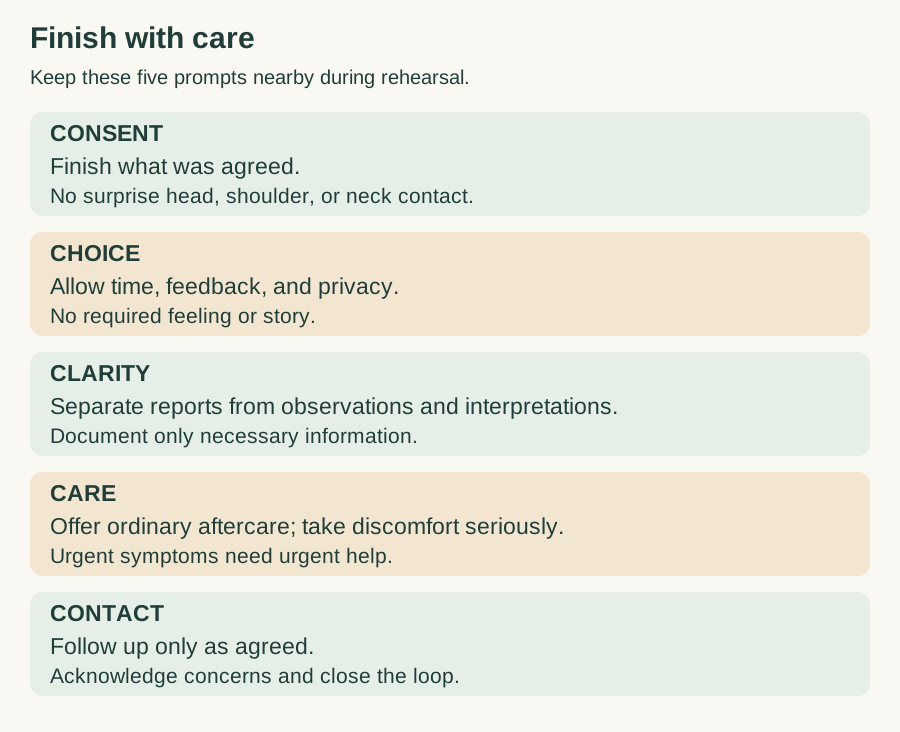
Pocket guide · Finish with care

Pocket guide for closing, documenting and following up

  • Complete agreed contact; avoid adding untaught or unconsented areas.
  • Release gently; preserve support, covering, dignity, and time.
  • Check alertness and comfort before water or movement.
  • Ask a neutral question; allow silence, criticism, and no change.
  • Offer ordinary aftercare; do not explain symptoms as healing.
  • Document reports, actions, observations, and next steps separately from interpretations.
  • Protect the record and use only appropriate learning copies.
  • Follow up only as agreed; respond promptly and appropriately to concerns.

Three phrases to remember: “What, if anything, would you like to share?” “I can't determine what caused that.” “What would you prefer next?”

Production & sources

Sources, attribution, and production notes

Sources checked September 24, 2026. These sources support the specific statements identified in the lessons; they do not validate the whole sequence or grant a license to practice.

What came from Ruth

The quiet closing approach, grounding imagery, heel and foot contact, optional head/shoulder sequence, scarf and covering removal, equipment removal, water offer, open invitation to share, remembering preferences, interest in client-defined meaning, and discussion of dreams and difficult experiences come from the supplied account. The source-extract companion preserves selected wording and the distinction between account and curriculum.

What was added for teaching

The seven-lesson structure, timing, feet-only beginner boundary, proposed scripts, factual notes form, all fictional cases, privacy process, aftercare limits, emergency guidance, follow-up templates, assessment, and visual guides are additions. The source account's phrase “very light crayon sheet” is unclear; this draft uses “light covering” without guessing a fabric. No device brand, author recommendation, state exemption, or retention period has been invented.

Before recording or professional adoption

Ruth should review the narration for voice and accuracy. Demonstration filming must use already taught, appropriate techniques and a consenting partner. The actual jurisdiction, credentials, equipment, record requirements, retention policy, messaging process, and complaint policy need practice-specific verification. Written material and rehearsal activities are complete drafts; this package contains no recorded videos and is not a legal or clinical compliance certification.

A note for this section

Review workspace

Where your comments live

Connect to the website to share notes with each other. On a static host, use this browser and export your comments to share them.

The access code is in the separate upload guide. Everyone with it can read, edit and resolve review notes.


Device comments are kept in this browser, not sent to anyone. Export a backup before clearing browser data or switching devices.